pátek 15. července 2016

The English Version

Three Days in Moravian Beskydy The Range

The Part Two/ On The Top of Pluskovec The Hill
The Fig.1: A happy fool on the hill called Pluskovec, Moravian Beskydy
The Range. 6.9. 2016, Samsung Galaxy, S7.

I began to gave the thought to find the Coral Root Orchid up somewhere under the top of Pluskovec the hill where the forest was changing into the mountainous meadows. In the course of our climb up we recorded no plant of this species in all the long sylvan section. Its character was very similar to the one in Český Kras the region.

The Fig.2: The happy Fool on the top of Pluskovec the hill once again.
Moravian Beskydy the Range, 6.9. 2016, Samsung Galaxy, S7.

And for a time I forgot it at all when we stood up on the top of the hill. We could enjoy beautiful panoramas of the surrounding landscape. We took a short rest on the top. The weather was ideal, the Sun was shining, except for sporadic white innocent clouds the sky was blue and then views of the landscape from the top gave a fascinating scenery to us. It was warm, I had a shirt with no sleeves. In a moment a beetle rested on my son´s hand and I was ready enough to caught its shot up by my smart phone. I identified it after our return to Prague.

I took a lot of pictures of the landscape on the top and besides, in an euphoria, I asked my son for to photo me, too. Now you can have an unique occasion to see one happy fool on the hill in this post.
The Fig.3: This beetle rested on my son´s hand on the top of Pluskovec at Velké Karlovice
the settlement, Moravian Beskydy the Range. A time later I identified it at home as to be
Melasoma populi, an abundant species, no rarity. 6.9. 2016. Samsung Galaxy, S7.

What should I write more about our stay on the long back of Pluskovec the hill? Maybe that I felt a pleasant satisfaction I was there, that after the long climb up to stand on the top of the hill was a splendid award to me. Surely my photos will do a better work than my text in this while.
The Fig.4: A view of the surrounding landscape behind my back a couple of
meters under of the top of Pluskovec the hill, Moravian Beskydy the Range.
6.9. 2016. The shot was taken by my Canon.


The Czech Version

Tři dny v Moravských Beskydech

Část II/ Na vrcholu Pluskovce

Myšlenku najít korálici jsem začal vzdávat někde pod vrcholem Pluskovce, kde les přecházel v horské louky. Během výstupu jsme nezaznamenali žádnou rostlinu tohoto druhu v celém dlouhém lesnatém úseku. Jeho charakter se velmi podobal tomu v Českém Krasu. A na čas jsem na ni zapomněl úplně, když jsme stanuli na vrcholu kopce. Mohli jsme si užívat nádherných panorámat okolní krajiny. Počasí bylo ideální, Slunce svítilo, až na sporadické bílé nevinné oblaky byla obloha modrá, a tudíž výhledy na krajinu z vrcholu nám poskytovaly fascinující scenérii. Bylo teplo, měl jsem triko bez rukávů. V jedné chvíli na synově ruce přistál nějaký brouk a já byl dost pohotový, abych jeho obrázek zachytil svým chytrým mobilem. Určil jsem ho po návratu do Prahy.
The Fig.5: Under the top of Pluskovec the hill in front of me. You can see
a part of its long back. Our friend Vendy in a meadow
to the right side of our way up to the top. 6.9. 2016, taken by my Canon.

Na vrcholu jsem pořídil hodně obrázků krajiny a navíc, v jakési euforii jsem požádal syna, aby vyfotil také mě. Teď máte v tomhle postě jedinečnou příležitost vidět jednoho šťastného blázna na kopci.

Co víc bych měl psát o našem pobytu na dlouhém hřbetě kopce Pluskovce? Snad, že jsem cítil příjemné uspokojení, že tam jsem, že stát na vrcholu toho kopce po dlouhém výstupu je pro mě báječnou odměnou. Moje fotografie jistě udělají v tuhle chvíli lepší práci než mé texty.

Česká verze popisků pod obrázky:

Obr.1: Šťastný blázen na kopci zvaném Pluskovec, Moravské Beskydy. 9.6. 2016, Samsung Galaxy, S7.
The Fig.6: A view of the wavy backs of many hills from the top of Pluskovec
the hill in Moravian Beskydy the Range. 6.9. 2016. Taken by my Canon.

Obr.2: Šťasný blázen na vrcholu kopce Pluskovce ještě jednou. Moravské Beskydy, 9.6. 2016, Samsung Galaxy, S7.
The Fig.7: The closer view of the panorama on the previous shot. The top of
Pluskovec the hill, Moravian Beskydy the Range, 6.9. 2016, Canon.

Obr.3: Tento brouk přistál na ruce mého syna na vrcholu Pluskovce u osady Velké Karlovice, Moravské Beskydy. Po nějakém čase jsem ho doma určil jako mandelinku topolovou (Melasoma populi), hojný druh, žádná vzácnost. 9.6. 2016, Samsung Galaxy, S7.

Obr.4: Pohled na okolní krajinyu za mými zády pár metrů pod vrcholem kopce Pluskovce, Moravské Beskydy. 9.6. 2016. Tato fotka byla pořízena mým Canonem.

Obr.5: Pod vrcholem kopce Pluskovce přede mnou. Vidíte část jeho táhlého hřbetu. Náš přítel Venda v louce po pravé straně naší cesty vzhůru k vrcholu. 9.6. 2016, pořízeno mým Canonem.
The Fig.8: The path on the top of Pluskovec the hill leading to our climb down. Moravian
Beskydy the Range, 6.9. 2016, taken by my Canon.

Obr.6: Pohled na zvlněné hřbety mnoha kopců z vrcholu kopce Pluskovce v Moravských Beskydech. 9.6. 2016. Pořízeno mým Canonem.

Obr.7: Bližší pohled na panorama na předešlém snímku. Vrchol kopce Pluskovce, Moravské Beskydy, 9.6. 2016, Canon.
The Fig.9: The Happy Fool is leaving the top of Pluskovec the hill, Moravian Beskydy.
6.9. 2016. Samsung Galaxy, S7.

Obr.8: Cesta na vrcholu kopce Pluskovce vedoucí k našemu sestupu. Moravské Beskydy, 9.6. 2016, pořízeno mým Canonem.

Obr.9: Šťastný blázen opouští vrchol kopce Pluskovce, Moravské Beskydy. 9.6. 2016. Samsung Galaxy, S7.

pondělí 11. července 2016

The English Version

Three Days in Moravian Beskydy The Range

The Part Two/ The Climb Up To Pluskovec The Hill

It would be very good
to find the Coral Root Orchid
in this wood
(My own ding-dong)
The Fig.1: Orchis mascula ssp. signifera with typical purple points in the white center of
the labium. Our first found orchid in Moravian Beskydy The Range. It was found at the
foot of Pluskovec the hill. 6.9. 2016. The photo was taken by my smart phone, Samsung
Galaxy, S7.

After our unsuccessful searching for the Coral Root Orchid (Collarorhiza trifida) in Český Kras the region in Bohemia I have not given the thought to find it up still. Why could not I find it in any else habitat if the time of its flowering has still been actual? Why could not it grow in any dense forest in Beskydy The Range? This was why I started studying various preserved habitats in the destination we were going to visit to. Mostly I learnt that its occurrence in Beskydy The Range was a past. It was found in various localities there a time before but now it did not grow in them already. Still I found one habitat in Moravian Beskydy The Range where its occurrence was presented till this time: Pluskovec the hill near to Velké Karlovice the settlement. By this way just Pluskovec the hill became to be the first object of our greatest interest.
The Fig.2: Dactylorhiza majalis ssp. majalis grew nearby to the previous plant. 6.9. 2016.
I took this photo by my smart phone, Samsung Galaxy, S7 at the foot of Pluskovec the hill.

The ding-dong under the title of this post I thought out on our way up to the top of Pluskovec the hill to stimulate my companions in searching for the Coral Root Orchid.
By Vendy´s car we were in the place within a short while. The car was left at the foot of the hill and our next way by foot continued on in the steeper and steeper climb up. First the climb up was mild and the path was lined with a dense, taller and colorful vegetation consisting of manifold herbs and grasses. When we left last house behind our backs my companions before me announced the first finding of an orchid in the growth alongside the path. It was our first orchid in Moravian Beskydy The Range absolutely. Most of its flowers were fading away but while I was staying with it and I was taking some pictures of it my boys were announcing a next orchid growing nearby the first one. A while later I could see that the second plant was different from the first one. It was an orchid, too, but its flowers had different drawing on their labia.
The Fig.3: Two "flowering heads" of Dactylorhiza majalis ssp. majalis drowned in
the dense surrounding vegetation of the wet ditch alongside our path. 6.9. 2016.
The photo was taken at the foot of Pluskovec the hill by my smart phone Samsung
Galaxy, S7.
There were a lot of various herbs to the left side of the field path. It was a wet ditch covered with a dense vegetation and rightly behind it a steep slope rose up. The opposite side of the path was lined with a forest and a slanted terrain began to climb up further in it. While the left side was open the right side was shadowy. Near to the right side of the path a stream was going through the forest. In the moment I experienced the well known effect caused by too much impulses coming in your brain.
The Fig.4: On the opposite side of our field path I could not miss a big marked plant growing
in the mixed forest near to the stream. Even though I saw this plant in the wild at the first time in
my life I evoked its Czech botanic name almost immediately: Samorostlík klasnatý! Its Latin name
is Actaea spicata. It belongs to Ranunculaceae the family. 6.9. 2016, the photo taken by my
smart phone, Samsung Galaxy, S7 at the foot of Pluskovec the hill.

A while later we went to a place where there were two sylvan paths. We took the one turning to the right. Here our climb up began in the middle of an adult mixed forest. Here I gave a signal to my companions to devote their maximal efforts to the sylvan unnoticeable orchid which we went to search for there. The terrain seemed to be very convenient to the Coral Root Orchid. 
The Fig.5: A whole view of Actaea spicata growing in the forest at the foot of Pluskovec the hill.
The tiny flowers arranged in a wide panicle consisting of separate spikelets were not opened yet.
6.9. 2016.


The way climbing up and up was the only place where no trees grew. The scheme of our searching was similar to the one in Český Kras the region in Bohemia. First of all we payed our attention to margins of the path and from time to time we left the path and entered sylvan rooms further from it.

To be continued.


The Czech Version

Tři dny v Moravských Beskydech

Část druhá/ Výstup na kopec Pluskovec

Najít korálici v tomhle lese
by bylo moc bezva
(vlastní slogan)

The Fig.6: This plant names Majanthemum bifolium in Latin and I have seen it many times
but first I have seen it in flower at the foot of Pluskovec the hill. 6.9. 2016.


Po našem neúspěšném pátrání po korálici troklané (Corallorhiza trifida) v Českém Krasu v Čechách jsem se myšlenky najít ji pořád nevzdával. Proč bych ji nemohl najít na nějaké jiné lokalitě, je-li doba jejího kvetení stále aktuální? Proč by nemohla růst v nějakém hustém lese v Beskydech? Proto jsem začal studovat různé chráněné lokality v destinaci, kterou jsme se chystali navštívit. Převážně jsem se dozvěděl, že její výskyt v Beskydech je minulostí. Byla tam před nějakým časem nacházena na různých lokalitách, ale dnes už na nich neroste. Přesto jsem našel jednu lokalitu v Moravských Beskydech, kde se její výskyt uváděl až dodnes: Kopec Pluskovec poblíž osady Velké Karlovice. Tímto způsobem se právě kopec Pluskovec stal prvním objektem našeho nejvyššího zájmu.
The Fig.7: One inflorescence of M. bifolium in more detail. 6.9. 2016.

Říkanku pod titulem tohoto postu jsem vymyslel cestou vzhůru k vrcholu Pluskovce, abych povzbudil své společníky v pátrání po korálici. Anglicky se rýmuje, zde její obsah přeložím volně a prostou rýmu: "Najít korálici v tomhle lese by bylo moc bezva".
The Fig.8: We were passing by last cottages on our way to the top of
Pluskovec the hill. The photo was taken by my Canon. 6.9. 2016.

Vendovým autem jsme byli na místě během chvilinky. Auto bylo zanecháno na úpatí kopce a naše další cesta pěšky pokračovala ve stále strmějším stoupání. Zprvu byl výstup mírný a cestu lemovala hustá, vyšší a pestrá vegetace sestávající z rozmanitých bylin a travin. Když jsme zanechali za zády poslední dům, moji druzi přede mnou oznámili první nález orchideje v porostu podél cesty. Byla to naše absolutně první orchidea v Moravských Beskydech. Většina jejích květů uvadala, ale zatímco já jsem u ní zůstával a pořizoval její obrázky, moji hoši hlásili další orchideu rostoucí opodál té první. O chvíli později jsem viděl, že druhá rostlina se od první liší. Taky to byla orchidej, ale její květy měly na pyscích jinou kresbu.
The Fig.9: The steep slope to our left side rightly behind the ditch next to
the path at the foot of Pluskovec the hill. 6.9. 2016. The photo was taken
by my Canon.

Na levé straně polní cesty byla spousta různých bylin. Byla to mokrá škarpa zarostlá hustou vegetací a hned za ní se zvedal strmý svah. Protější stranu cesty lemoval les a šikmý terén začínal stoupat dále v něm. Zatímco levá strana byla otevřená, pravá byla stinná. Poblíž pravé strany cesty protékal lesem potok. V té chvíli jsem zažíval dobře známý efekt způsobený příliš mnoha podněty, které vám přichází do mozku.

Po chvíli jsme došli k místu, kde byly dvě lesní cesty. Vydali jsme se tou, která se stáčela doprava. Tady náš výstup začal uprostřed zralého smíšeného lesa. Tady jsem vydal signál mým společníkům, aby věnovali maximální úsilí lesní nenápadné orchideji, po níž jsme tam přišli pátrat. Cesta stoupající stále výš byla jediným místem, kde stromy nerostly. Schéma našeho pátrání se podobalo tomu v Českém Krasu v Čechách. Především jsme věnovali pozornost okrajům cesty a tu a tam jsme cestu opouštěli a vstupovali do lesních prostor dále od ní.
The Fig.10: I came upon this amphibian in a place where our way turned to the right. I think
this frog is Rana temporaria. Its coloration fuses with its surroundings almost perfectly.
Pluskovec the hill, 6.9. 2016. The shot was caught by my Canon.


Česká verze popisků pod obrázky:

Obr.1: Vstavač mužský znamenaný (Orchis mascula ssp. signifera) s typickými nachovými puntíky v bílém středu pysku. Naše první nalezená orchidej v Moravských Beskydech. Byla nalezena na úpatí kopce Pluskovce. 9.6. 2016. Foto bylo pořízeno mým chytrým mobilem Samsung Galaxy, S7.
The Fig.11: This herb with white flowers is Sanicula europaea. Also it was present in the habitat
where we searched for the Coral Root Orchid at the first time. 6.9. 2016. Pluskovec the Hill. 

Obr.2: Prstnatec májový pravý (Dactylorhiza majalis ssp. majalis) rostl opodál předešlé rostliny. 9.6. 2016. Tento snímek jsem pořídil svým chytrým mobilem Samsung Galaxy, S7 na úpatí kopce Pluskovce.
The Fig.12: Neottia nidus-avis again. We had seen this orchid in Český Kras the region at the
first time and we could observe it in the sylvan terrain of Pluskovec the hill, too. We could see
many plants of this species there. 6.9. 2016

Obr.3: Dvě "kvetoucí hlavy" prstnatce májového pravého (D. majalis ssp. majalis) utopené v husté okolní vegetaci vlhké škarpy podél naší cesty. 9.6. 2016. Foto bylo pořízeno na úpatí kopce Pluskovce mým chytrým mobilem Samsung Galaxy, S7.
The Fig.13: You can find more plants of N. nidus-avis in this sylvan terrain
of Pluskovec the hill. 6.9. 2016.

Obr.4: Na opačné straně cesty jsem nemohl přehlédnout velkou nápadnou rostlinu rostoucí ve smíšeném lese poblíž potoka. I když jsem rostlinu viděl v přírodě poprvé v životě, téměř bezprostředně jsem si vybavil její český botanický název: samorostlík klasnatý! Latinsky se jmenuje Actaea spicata. Patří do čeledi pryskyřníkovitých (Ranunculaceae). 9.6. 2016. Foto pořízeno mým chytrým mobilem Samsung Galaxy, S7 na úpatí kopce Pluskovce.

Obr.5: Celkový pohled na samorostlík klasnatý (A. spicata) rostoucí v lese na úpatí kopce Pluskovce.
Drobné květy uspořádané v široké latě sestávající z jednotlivých klásků nebyly ještě otevřené. 9.6. 2016.

Obr.6: Tahle rostlina se jmenuje latinsky Majanthemum bifolium (pstroček dvoulistý) a viděl jsem ji mnohokrát, ale poprvé jsem ji viděl v květu na úpatí kopce Pluskovce. 9.6. 2016.

Obr.7: Jedno květenství pstročku dvoulistého (M. bifolium) detailněji. 9.6. 2016.

Obr.8: Procházeli jsme zrovna kol posledních chalup cestou na vrchol kopce Pluskovce. Snímek byl pořízem Canonem. 9.6. 2016.

Obr.9: Strmá stráň  po naší levé straně hned za škarpou vedle cesty na úpatí kopce Pluskovce. 9.6. 2016. Foto bylo pořízeno Canonem.
The Fig.14: The same shot as it is on the previous photo in more detail
(for the blind). 6.9. 2016.

Obr.10: Na tohoto obojživelníka jsem narazil v místě, kde se cesta stáčela doprava. Myslím, že tahle žába je skokan hnědý (Rana temporaria). Její zbarvení splývá s okolím téměř dokonale. Kopec Pluskovec, 9.6. 2016. Snímek byl zachycen mým Canonem.

Obr.11: Tahle bylina s bílými květy je žindava evropská (Sanicula europaea). Byla rovněž přítomna na lokalitě, kde jsme po korálici pátrali poprvé. 9.6. 2016. Kopec Pluskovec.

Obr.12: Hlístník hnízdák (Neottia nidus-avis) opět. Tuhle orchideu jsme poprvé viděli v oblasti Českého Krasu a mohli jsme ji pozorovat také v lesnatém terénu kopce Pluskovce. Viděli jsme tam mnoho rostlin tohoto druhu. 9.6. 2016.

Obr.13: Můžete si hledat další hlístníky hnízdáky (N. nidus-avis) v tomto zalesněném terénu kopce Pluskovce. 9.6. 2016.

Obr.14: Tentýž snímek jako na předešlém obrázku detailněji. (pro slepé). 9.6. 2016.

Pokračování příště

sobota 9. července 2016

The English Version

Three Days in
Beskydy The Moravian Mountains

The Part One

From Prague to Karolínka The Settlement
The Fig.1: The parking lot in Karolínka the settlement in the backyard of our pension.
On 6.8. 2016. The shot was taken from the veranda of our room.Tuesday was
nearing to its midnight. We were in the heart of Moravian Beskydy The Range.

This mountainous landscape is very old judging from its very long and round tops covered with large forests and mountainous meadows. It is formed by hills rather than mountains. They do not reach for the sky, they are no Himalayas, they are not ragged and high as Vysoké Tatry the Range in Slovakia. Despite this they have their authentic beauty and an idyllic atmosphere.
The Fig.2: A view of the entrance to the parking lot over roofs from our veranda. The only lamp
lighted in the blackness. 6.8. 2016, it was the midnight time.

By their appearance they resemble other old ranges in my country of which tops have been modified by the geologic times in the present lower hills with their mild wavy silhouettes as you can see them if you are standing on a top of many others of this range and you can overview the surrounding landscape.
The Fig.3: A part of our kitchen in our room in Karolínka
the settlement. 6.8. 2016

The Beskydy Range is not confined to the Moravian region only. It stretches out also to Silesia, to Poland as well as to Slovakia. But these parts of Beskydy the Range bare their own names. We (our usual trio, see some of my previous posts) visited to the Moravian part of this range. Our accommodation was booked by my son in advance. It was in a pension in Karolínka a small settlement between Velké Karlovice to the East of it and Vsetín the town to the West of the settlement lost in a long valley among hills and distributed alongside a common road.

We started going to Karolinka from Prague by Vendy´s car on 6.8. 2016 at 17.00 P.M.. The way took more than four hours, we were there several minutes after half past ten in the evening. While we were finding the pension its receptionist was calling to my son where we were. You see, it was a late time, no wonder she wanted to know if our visit was certain still. Thanks to her navigation we found the pension with no next problems and we could park the car in a parking lot in a backyard of the pension for the guests.

After the usual formalities the sleepy receptionist took us to our room. We could see that it consisted of three separate rooms with a perfect kitchen, a WC and a bathroom plus with a roofed veranda where me and my son (our friend Vendy does not smoke) could smoke without we had to step down to the backyard for every cigarette. I must add that our room was rightly under the roof of the pension.
The Fig.4: The kitchen was equipped with all you
could need. There is a bed in the lower corner to the left.
My son choose to sleep in it.
6.8. 2016

What were our purposes in this destination? First of all we wanted to explore as more habitats as possible in this region of our country. The region has been very well known among both amateur and professional botanists with an abundant occurrence of various species of the orchids. And then we hoped we could find some of them. Of course, this botanical purpose was mainly my cup of tea but both my attendants accepted it with a great understanding because, after several previous field trips, they had already been caught by the magic of some species of the orchids growing in Czech republic.They had become to be the hunters of our orchids almost in a noticeable and spontaneous way. Finding rare orchids in various terrains has become an adventurous amusement to them. Unlike them I have been led by the deeper interest in the orchids from the point of botany and of biology as well. But the two accesses do not exclude each other.

The second target was to visit to Vsetín the town because it was my Mother´s birthplace. I had never been there till that time. And Karolínka the settlement, the place of our accommodation, was only 17 km distant from it.
The Fig.5: I could not help myself but I had to take a picture
of this small room, too. Why? Because of the slanted
ceiling above the WC. If you are tall and a man then you
may have certain problems with your position above it.
6.8. 2016

The third reason why to visit this region was connected with an idea of my favorite Celts. Surprisingly the Walachian country (of which Vsetín the town is a part) is known with the high frequency of genes eliciting the cystic fibrosis in the local population, the illness typical of the Celts. It is an alone islet of the Celtic culture in the center of Europe. This disease correlates with the Celts in other areas of Europe (Wales, Irish, England, Scotland, Brittany etc.). I thought we could visit to a museum devoted to this topic somewhere there.


Well, we were accommodated very comfortably and Tuesday was nearing to its end. We sat in the veranda and gazed at the silent darkness in front of us. We talked about our plans for next day. The sky was clear and we could observe stars. Vendy used the astronomic program in its smart phone and due to it he could identify two planets visible in the sky at that time. We could look at a rare event: Mars and Saturn were in front of our eyes in the same time. I tried to take some photos of the sleeping surroundings from the veranda but mostly the shots were portraits of the Madam Night than anything else.
The Fig.6: The shower would be more convenient to Tyrion
Lannister rather than to a normal tall man due to the
slanted ceiling. 6.8. 2016

It was several minutes after the midnight when we finished our sitting in the veranda. It took no long time and we were in our beds. I fell into a deep sleep almost immediately in the unusual silence and the blackness.

To be continued.


The Czech Version

Tři dny v Beskydech

Část první

Z Prahy do osady Karolínka

Tahle horská krajina je velmi stará soudě podle jejích táhlých a oblých vrcholů pokrytých rozsáhlými lesy a horskými loukami. Utvářejí ji spíše kopce než hory. Nedosahují oblohy, nejsou to žádné Himaláje, nejsou rozeklané a vysoké jako Vysoké Tatry na Slovensku. Vzdor tomu mají svou osobitou krásu a idylickou atmosféru.

Vzhledem se podobají jiným pohořím v mé vlasti, jejichž vrcholy upravily geologické doby v současné nižší kopce s mírnými zvlněnými siluetami, jak je vidíte, stojíte-li na nějakém vrcholu tohoto pohoří a můžete přehlížet okolní krajinu.
The Fig.7: My bedroom. One extra bed. Our friend Vendy
had the same bedroom. 6.8. 2016

Beskydské pohoří se neomezuje pouze na moravskou oblast. Prostírá se rovněž do Slezska, do Polska a na také na Slovensko. Ale tyhle části Beskyd nesou svá vlastní jména. Naše obvyklé trio (viz některé z mých předešlých postů) navštívilo moravskou část tohoto pohoří. Ubytování nám můj syn zabukoval předem. V penzionu v Karolínce, malé osadě mezi Velkými Karlovicemi východně od ní a Vsetínem západně od téhle vísky ztracené v dlouhém údolí mezi kopci a rozložené podél obyčejné silnice.

Vyjeli jsme do Karolínky z Prahy Vendovým autem 8.6. 2016 v 17.00 hodin večer. Cesta trvala přes čtyři hodiny, byli jsme tam několik minut po půl jedenácté v noci. Zatímco jsme hledali penzion, jeho recepční zavolala synovi, kde jsme. To víte, bylo pozdě, žádný div, že chtěla vědět, je-li naše návštěva stále jistá. Díky její navigaci jsme našli penzion bez dalších potíží a auto jsme mohli zaparkovat na parkovišti zadního dvora penzionu pro hosty.

Po obvyklých formalitách nás ospalá recepční uvedla do našeho apartmá. Viděli jsme, že sestává ze tří oddělených místností s dokonalou kuchyní, toaletou a koupelnou plus se zastřešenou verandou, kde jsme já a syn (náš přítel Venda nekouří) mohli kouřit, aniž bychom museli na každou cigaretu sestupovat na dvůr. Musím dodat, že naše apartmá bylo přímo pod střechou penzionu.
The Fig.8: The backyard of the pension in Karolínka the settlement in the daylight. It was
on Thursday, 6.9. 2016, in the morning.

Jaké byly naše cíle v téhle destinaci? Především jsme chtěli prozkoumat co možná nejvíc přírodních lokalit v této oblasti naší země. Oblast je velmi dobře známá jak mezi amatérskými tak i profesionálními botaniky bohatým výskytem různých druhů orchidejí, takže jsme doufali, že bychom některé z nich mohli najít. Samozřejmě, že tento cíl byl především můj šálek čaje, ale oba moji společníci ho přijali s velkým porozuměním, protože je už, po několika předcházejících terénních výletech, polapilo kouzlo některých příslušníků orchidejí rostoucích v České republice. Stali se lovci našich orchidejí skoro nepozorovaně a spontánně. Hledání vzácných orchidejí se jim stalo dobrodružnou zábavou. Na rozdíl od nich já jsem veden hlubším zájmem o orchideje z hlediska botanického a také biologického. Ale tyhle dva přístupy se vzájemně nevylučují.
The Fig.9: There is a dark green screen of the coniferous forest
on the background of this shot. On Thursday, 6.9. 2016.

Druhým cílem bylo navštívit město Vsetín, protože bylo rodištěm mé matky. Do té doby jsem tam nikdy nebyl. A Karolínka, místo našeho ubytování, je od něj vzdálena pouhých 17 km.

Třetí důvod, proč navštívit tuhle oblast, byl spojen s představou mých oblíbených Keltů. Překvapivě, Valašsko (jehož součástí je Vsetín) je známo vysokou frekvencí genů vyvolávajících cystickou fibrózu, chorobu typickou pro Kelty. Je osamoceným ostrůvkem keltské kultury uprostřed Evropy. Tato choroba koreluje s Kelty v jiných evropských oblastech (Wales, Irsko, Anglie, Skotsko, Bretaň atd.). Domníval jsem se, že bychom tam někde mohli navštívit museum zasvěcené tomuhle tématu.
The Fig.10: Our veranda. On Thursday, 6.9. 2016, in the
morning. To smoke permitted.

Nu, byli jsme pohodlně ubytováni a středa se blížila ke svému konci. Usadili jsme se na verandě a zírali jsme do tiché temnoty před sebou. Rozmlouvali jsme o plánech na příští den. Obloha byla jasná a my mohli pozorovat hvězdy. Venda použil astronomický program ve svém chytrém mobilu a díky jemu mohl určit dvě planety viditelné na nebi v tom čase. Mohli jsme se dívat na vzácnou událost: Před našimi zraky byly současně Mars a Saturn. Já jsem se pokusil pořídit nějaké obrázky spícího okolí z verandy, ale povětšinou jsou ty fotky spíše portréty paní Noci, než čehokoliv jiného.

Bylo několik minut po půlnoci, když jsme sezení na verandě ukončili. Netrvalo dlouho a byli jsme v postelích. V tom neobvyklém tichu a temnotě jsem upadl do hlubokého spánku skoro okamžitě.

Pokračování příště.

Česká verze popisků pod obrázky:

Obr.1: Parkoviště v osadě Karolínka na zadním dvoře našeho penzionu. 8.6. 2016. Záběr byl pořízen z verandy našeho apartmá. Středa se blížila k půlnoci. Byli jsme v srdci Moravských Beskyd. 

Obr.2: Pohled na vjezd na parkoviště přes střechy z naší verandy. V temnotě svítila jediná lampa. 8.6. 2016, byl půlnoční čas. 

Obr.3: Část kuchyně v našem apartmá v osadě Karolínka. 8.6. 2016.
The Fig.11: The blue sky with white clouds promised a good weather.
There were rising up backs of hills covered with forests and meadows
behind the roofs. A while later we started preparing for our first field
trip. On Thursday, 6.9. 2016, in the morning.
All my photos in this post were taken by my new smart phone, Samsung
Galaxy, S7.


Obr.4: Kuchyň byla vybavena vším, co byste mohli potřebovat. V levém dolním rohu je lůžko. V něm si vybral spát můj syn. 8.6. 2016.

Obr.5: Nemohl jsem si pomoci, ale musel jsem vyfotit obrázek také téhle místnůstky. Proč? Kvůli skosenému stropu nad záchodem. Jste-li vysoký a muž, pak můžete mít jisté problémy s pozicí nad ním.

Obr.6: Vzhledem ke skosenému stropu by sprcha byla příhodnější pro Tyriona Lannistera než pro normálně vysokého muže.

Obr.7: Moje ložnice. Jedno lůžko navíc. Náš přítel Venda měl stejnou ložnici.

Obr.8: Zadní dvůr penzionu v osadě Karolínka v denním světle. Byl čtvrtek, 9.6. 2016 ráno.

Obr.9: Na pozadí snímku je tmavozelená clona jehličnatého lesa. Čtvrtek, 9.6. 2016.

Obr. 10: Naše veranda. Ve čtvrtek, 9.6. 2 016, ráno. Kouřit polovoleno. 

Obr.11: Modrá obloha s bílými mraky slibovala dobré počasí. Za střechami se zvedaly hřbety kopců porostlé lesy a loukami. O chvíli později jsme se začali připravovat na první terénní výlet. Čtvrtek, 9.6. 2016, ráno.
Všechny mé fotky v tomto postu byly pořízeny mým novým chytrým mobilem, Samsung Galaxy, S7.

úterý 5. července 2016

The English Version

We and the Rest of the World
or
from The Brexit to The Brexitus

The Part II
The Fig.1: Which the Big Ben (Bang) has tolled for? For the UK or for The EU? Maybe It has
tolled for the whole Europe.

I have felt myself as to be The European man. But after the referendum in The UK on Thursday,
the 23-th June, 2016, my feeling that I have been the European man has been rather shrunk. If I read in my feelings then I can decode their text like a great loss.
The Fig.2: The Big Ben (Bang) in the dusk.

Fortunately, the Universe, according to the astronomers, the theoretical physicists and the other experts in the Universe at least, has still been doing the opposite work - it has been expanding. Unlike the shrinking EU. 28 - 1 = 27.

Well, my awareness of the strong and compact EU which I have been a member of has been hurt by the UK act very badly. Should I ascribe my sadness to the Englishmen? Why did they decide to leave the EU? As usually, the only thing what I can do is to speculate about it. I do not know the exact answer to this question.I have got it neither from the world mass media nor from our ones.
The Fig.3: The Tower Bridge.

At the first glance nothing so terrible happened. In geographic terms, The UK islands have still been there where they have always been, neither they drowned in the sea nor they were launched to the cosmos to take their positions on the Moon or on the Mars. Nothing similar happened.

But the islands are not barren, they are inhabited by a very sturdy nation called the Englishmen.Their history has been rich, long and bloody and it has been full of the struggle for a life, for a power, for a place better exposed to the Sun. As the islanders, though they have been the part of the Europe, they have been separated from the rest of the world as they like to define ourselves: "We and the rest of the world."
The Fig.4: A view of the Tower Bridge from the Queen´s Walk.

The more isolated islands the more specific developments of their living beings including the man.
Besides, and it is a next very important factor of the nation called the Englishmen, if you live on an island you must learn to face to the element surrounding you from all the world sides. The natural element is the sea. And The Englishmen have learnt not only to face to it but they have learnt to make use of it, too. They have discovered and occupied a lot of new lands due to their own invention, due to their great courage, due to their longing to know new unexplored areas of the world as well as due to the natural element surrounding their native islands.
The Fig.5: This big metal hook is possible to see in the Queen´s Walk.

And I should not forget the other notorious known and specific factors by which these islanders have been formed. I should point out to the specific influence of the warm Golf Stream and to the moist and foggy inland with the strong influences on their characters.

The factors, I have presented above, have formed their culture. It has been so manifold and strong that it has influenced and enriched the world culture of the whole mankind. No doubt, their culture in all its forms (sciences, arts, sports, advances in technology, philosophy etc.) have been adding a huge potential to the mankind´s knowledge. The English language has been the number one in the world communication. All the English cultural influences have got the rest of the world mostly spontaneously though I can not exclude some military efforts abroad in the English history.

But the proud Albion has never tried to conquest this world by force, simply mostly it has been able to achieve it by its own cultural influences in a peaceful way.
The Fig.6: A view of Thames from the Tower Bridge.

But The Englishmen are not the only nation living in these islands. Together with them the Scotsmen, the Welsh, the Irish have coexisted there. Their mutual relationships have been varying with the historic time. At the present times the Scotsmen´s tendencies to separate from the Englishmen have seemed to be the most obvious. Besides the today´s Old Good England has been over saturated with a lot of migrants from their many present or late colonies dispersed throughout the world. And so the pedigree Englishman has been becoming rarer and rarer. The pedigree Englishman has been losing his (her) dominant position in his (her) own country and in the world as well. Maybe this has been so because the today´s Englishman has not already been the pedigree one. The pedigree Englishman has been diluting himself in the same way as the Celts had diluted themselves in genoms of the other European nations. This has been the UK's last pre-mortal convulsion. This has been no Brexit, this has been the Brexitus.
The Fig.7: On the opposite bank of Thames with the Tower Bridge behind
this historic fort. 

Openly I admit here that my affinities to The UK have been very strong. My admiration and fascination of this island country has started in my early youth already. Then mainly it was through the classic English literature. A couple of years later this my positive relationship with this country became stronger by my increasing interest in the Nature because of Ch. S. Darwin, T.H. Huxley (Darwin´s great supporter), R. Hook (the botanist and Darwin´s good friend) and many other great naturalists. This country has always been an amazing hatchery of excellent scientists and no wonder if we know about the highest levels of The Cambridge University or The Oxford University.
And then the sixties of the past century came in my boyhood (I was five years old in 1960) and the four young boys from Liverpool have confirmed my bonds to this country forever. I would like to know which of the two alternatives in the referendum was done by Sir Paul McCartney. I would like to know John Lennon´s response to the referendum (We all live in the yellow submarine....!") or Ringo Star´s vote and at last but not least George Harrison´s response to the very tight victory of the Brexit supporters. Well, I would like to know it very much but two of the four ones have not been among us already, yeah, I know they have still been with us but somehow in a spiritual way only.
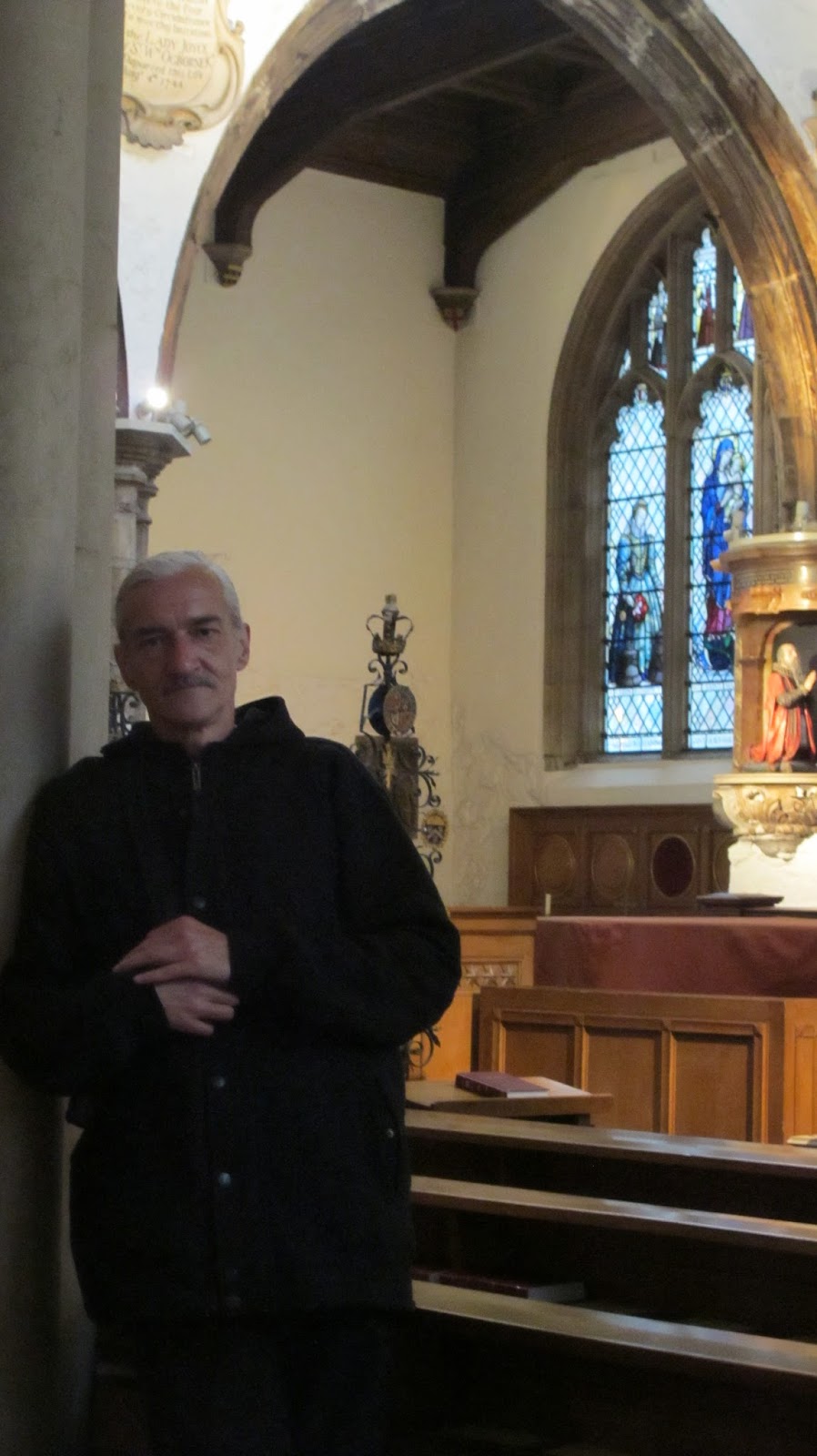
The Fig.8: In a church not far away from the Tower Bridge.
I look like a monk.

Paradoxically, to me The Big Ben (Bang) in London has already been no association connected with the origin of the Universe and its continuous expansion. Which it tolls for? occurs to me. For the UK? Or for the EU? Maybe it has tolled for the whole Europe. The prime minister D. Cameron has initiated a politic and economic suicide of his own country I would say. In the same time his decision to realize the referendum has made both his own country and the rest of the EU unstable extremely.
The Fig.9: This shot was taken from a double-decked bus going through
 a London street in the night time.

While the Universe has been expanding we, people, have been shrinking in smaller separate unites unable to collaborate together in one big unite. The result of the referendum was 52 to 48 percents for to leave the EU. The Brexit supporters won by 4 % only. This outcome has not seemed to me to be too much convincing. Almost a half of the voters has disagreed with the separation from the EU. There has been no one will to leave the EU in the UK. The only 4% decided to vote for this way. Then the only four percents have destabilized the whole Europe. Incredible? Unfortunately, this butterfly effect has been a real fact.

Is the referendum the right way how to make the crucial decisions? To my opinion the UK´s case has showed us nothing good. In short, I would like to have the UK back to the EU again.


The Czech Version

My a zbytek světa
aneb
od Brexitu k Brexitusu
The Fig.10: A strange building resembling a despotic oriental ruler.

Cítím se jako Evropan. Ale po referendu v UK 23. června 2016 se můj pocit, že jsem Evropan, dost smrštil. Čtu-li ve svých pocitech, pak ten text dekóduji jako velikou ztrátu.

Vesmír naštěstí, alespoň podle astronomů, teoretických fyziků a jiných odborníků na vesmír, nadále provádí opačnou práci - rozpíná se. Na rozdíl od smršťující se EU. 28 - 1 = 27.
Mé vědomí o silné a kompaktní EU, jejímž jsem členem, je aktem UK velmi ošklivě zraněno. Měl bych svůj smutek připisovat Angličanům? Proč se EU rozhodli opustit? Jediné, co s tím mohu dělat, je spekulovat o tom. Přesnou odpověď na tuhle otázku neznám. Nezískávám ji ani ze světových masmédií, ani z našich.
The Fig.11: The London´s Eye in the night.

Na první letmý pohled se nestalo nic tak hrozného. Geograficky jsou ostrovy UK pořád tam, kde jsou vždycky, ani se neutopily v moři, ani nebyly odpáleny do kosmu, aby zaujaly pozice na Měsíci či na Marsu. Nic podobného se nestalo.

Avšak ty ostrovy nejsou pusté, jsou obydleny velmi houževnatým národem zvaným Angličané. Jejich historie je bohatá, dlouhá a krvavá a je plná boje o život, o moc, o místo lépe vystavené slunci. Jako ostrované, třebaže jsou součástí Evropy, jsou od zbytku světa odděleni, jak sami sebe rádi definují:"My a zbytek světa".
The Fig.12: In the beginning there was an unnoticeable enter. When we walked
through it we found ourselves in this large open room surrounded with 
pompous Roman faces.

Čím izolovanější ostrovy, tím specifičtější vývoj jejich živáčků včetně člověka. Navíc, a to je další velmi výrazný faktor národa zvaného Angličané, žijete-li na ostrově, musíte se učit čelit živlu, který vás obklopuje ze všech světových stran. Tím přirozeným živlem je moře. A Angličané se mu naučili nejen čelit, ale naučili se ho také využívat. Objevili a zabrali spousty území díky vlastní vynalézavosti, díky velké odvaze, díky touze poznávat nové neprobádané oblasti světa a rovněž díky živlu, jenž jejich rodné ostrovy obklopuje.

A neměl bych zapomenut na další notoricky známé a specifické faktory, jimiž jsou tihle ostrované formováni. Měl bych poukázat na specifický vliv teplého Golfského proudu a na vlhké a mlhavé vnitrozemí se silným vlivem na jejich povahu.
The Fig.13: The Palace of Westminster and the Big Ben (Bang).

Faktory, které jsem uvedl výše, utvářely jejich kulturu. Je tak rozmanitá a silná, že ovliňuje a obohacuje světovou kulturu celého lidstva. Jejich kultura ve všech svých formách  (vědy, umění, sporty, technologické pokroky, filosofie atd.) nepochybně přidává ohromný potenciál ke znalosti lidstva. Angličtina je ve světové komunikaci jazykem číslo jedna. Veškeré anglické kulturní vlivy si získávají zbytek světa povětšinou spontánně, i když v anglické historii nemohu vyloučit některé militantní snahy v zahraničí.

Hrdý Albion však nikdy nezkoušel dobýt tento svět silou, prostě toho byl schopen dosáhnout převážně vlastními kulturními vlivy mírumilovně.
The Fig.14: A view of the Palace of Westminster with the Big Ben (Bang)
to the right.

Ale Angličané nejsou jediným národem žijícím na těchto ostrovech. Spolu s nimi tam spolužijí Skotové, Welshané a Irové. Jejich vzájemné vztahy kolísají s historickým časem. V současnosti se skotské tendence oddělit se od Angličanů zdají nejzřejmější. Navíc je dnešní Stará dobrá Anglie přesycena migranty ze svých dnešních či bývalých kolonií rozptýlených po celém světě. A tak se čistokrevný Angličan stává vzácnější a vzácnější. Čistokrevný Angličan ztrácí své dominantní postavení ve vlastní zemi a také ve světě. Snad proto, že dnešní Angličan už není čistokrevný. Čistokrevný Angličan se rozpouští stejně jako se Keltové rozpustili v genomech jiných evropských národů. Tohle je poslední předsmrtná křeč UK. tohle není Brexit, ale Brexitus.
The Fig.15: The Thames, the Palace of Westminster with the Big Ben (Bang)
 to the left side, the Big Ben (Bang) is almost in the center of this picture.
This shot was taken from one of many bridges going over the river.

Otevřeně tu připouštím, že mé vztahy k UK jsou velmi silné. Můj obdiv a fascinace touto ostrovní zemí započaly už v raném mládí. Tehdy to bylo hlavně prostřednictvím klasické anglické literatury. O pár let později můj pozitivní vztah k této zemi zesílil narůstajícím zájmem o přírodu, kvůli Ch.S. Darwinovi, T.H. Huxleymu (velký Darwinův stoupenec), R. Hookovi (botanik a Darwinův přítel) a mnoha dalším velkým přírodovědcům. Tahle země vždy byla ohromnou líhní vynikajících vědců a není divu, víme-li o nejvyšších úrovních univerzit v Cambridge a v Oxfordu. A poté do mého klukovství přišla šedesátá léta (v roce 1960 mi bylo 5 let) a moje pouta k této zemi navždy potvrdili čtyři hoši z Liverpoolu. Rád bych věděl, kterou z obou alternativ zvolil sir P. McCartney. Rád bych znal odezvu Johna Lennona na referendum (my všichni žijeme ve žluté ponorce.....) či hlas Ringo Stara a v neposlední řadě odezvu George Harrisona na velmi těsné vítězství stoupenců Brexitu. Moc rád bych to věděl, ale dva z těch čtyř už mezi námi nejsou, jo, vím, jsou s námi stále, ale jen jaksi spirituálně.
The Fig.16: Cascades like hyper-modern buildings are one of many new
 dominants alongside Thames the river in London.

Paradoxně, Big Ben (Bang) v Londýně už pro mne není asociací spojenou s původem vesmíru a jeho nepřetržitým rozpínáním. Komu zvoní hranu? napadá mě. UK? Nebo EU? Možná, že zvoní hranu celé Evropě. Řekl bych, že premiér D. Cameron inicioval politickou a ekonomickou sebevraždu vlastní země. Jeho rozhodnutí uskutečnit referendum současně extrémně destabilizovalo jeho zemi i zbytek EU.

Zatímco vesmír se rozpíná, my, lidé, se smršťujeme v menší samostatné jednotky neschopní spolupracovat pohromadě v jedné velké jednotce. Výsledek hlasování byl 52 ku 48 procentům pro opuštění EU. Zastánci Brexitu zvítězili o pouhá 4%. Tento výsledek mi příliš přesvědčivý nepřipadá. Skoro polovina voličů s oddělením od EU nesouhlasila. Opuštění EU v UK není jedné vůle. Pro tuto cestu rozhodla pouhá 4%. Pouhá 4% destabilizují celou Evropu. Neskutečné? Bohužel, tento motýlí efekt je reálný fakt.
The Fig.14: This picture from London is a nice conclusion of this post I think.

Je referendum ten správný způsob, jak dělat podstatná rozhodnutí? Podle mého názoru případ UK nám neukazuje nic dobrého. Zkrátka, rád bych měl UK zase zpět v EU.

České texty k obrázkům:

Obr.1: Komu Big Ben (Bang) zvoní hranu? UK? Nebo EU? Možná zvoní hranu celé Evropě.

Obr.2: Big Ben (Bang) v soumraku.

Obr.3: Tower Bridge.

Obr.4: Pohled na Tower Bridge z Královniny procházky.

Obr.5: Tento velký kovový hák lze spatřit na Královnině procházce.

Obr.6: Pohled na Temži z Tower Bridge.

Obr.7: Na protějším břehu Temže s Tower Bridge za touto historickou pevností.

Obr.8: V jednom kostele nedaleko od Tower Bridge. Vypadám jako nějaký mnich.

Obr.9: Tento snímek byl pořízen z dvoupatrového busu projíždějícího jednou londýnskou ulicí v nočním čase.

Obr.10: Podivná budova připomínající nějakého despotického orientálního vládce.

Obr.11: Oko Londýna v noci.

Obr.12: Na počátku byl nenápadný vchod. Když jsme jím prošli, ocitli jsme se v tomto rozsáhlém otevřeném prostoru obklopeném pompézními římskými fasádami.

Obr.13: Westminsterský palác s Big Benem (Bangem).

Obr.14: Westminsterský  palác s Big Benem (Bangem) vpravo.

Obr.15: Temže, Westminsterský palác s Big Benem (Bangem) nalevo, Big Ben (Bang) je skoro ve středu obrázku.
Snímek byl pořízen z jednoho z mnoha mostů překlenujících Temži.

Obr.16: Kaskádovité hypermoderní stavby jsou jednou z mnoha moderních dominant podél Temže v Londýně.

Obr.17: Myslím, že tento obrázek z Londýna je pěkným závěrem tohoto postu.