sobota 9. července 2016

The English Version

Three Days in
Beskydy The Moravian Mountains

The Part One

From Prague to Karolínka The Settlement
The Fig.1: The parking lot in Karolínka the settlement in the backyard of our pension.
On 6.8. 2016. The shot was taken from the veranda of our room.Tuesday was
nearing to its midnight. We were in the heart of Moravian Beskydy The Range.

This mountainous landscape is very old judging from its very long and round tops covered with large forests and mountainous meadows. It is formed by hills rather than mountains. They do not reach for the sky, they are no Himalayas, they are not ragged and high as Vysoké Tatry the Range in Slovakia. Despite this they have their authentic beauty and an idyllic atmosphere.
The Fig.2: A view of the entrance to the parking lot over roofs from our veranda. The only lamp
lighted in the blackness. 6.8. 2016, it was the midnight time.

By their appearance they resemble other old ranges in my country of which tops have been modified by the geologic times in the present lower hills with their mild wavy silhouettes as you can see them if you are standing on a top of many others of this range and you can overview the surrounding landscape.
The Fig.3: A part of our kitchen in our room in Karolínka
the settlement. 6.8. 2016

The Beskydy Range is not confined to the Moravian region only. It stretches out also to Silesia, to Poland as well as to Slovakia. But these parts of Beskydy the Range bare their own names. We (our usual trio, see some of my previous posts) visited to the Moravian part of this range. Our accommodation was booked by my son in advance. It was in a pension in Karolínka a small settlement between Velké Karlovice to the East of it and Vsetín the town to the West of the settlement lost in a long valley among hills and distributed alongside a common road.

We started going to Karolinka from Prague by Vendy´s car on 6.8. 2016 at 17.00 P.M.. The way took more than four hours, we were there several minutes after half past ten in the evening. While we were finding the pension its receptionist was calling to my son where we were. You see, it was a late time, no wonder she wanted to know if our visit was certain still. Thanks to her navigation we found the pension with no next problems and we could park the car in a parking lot in a backyard of the pension for the guests.

After the usual formalities the sleepy receptionist took us to our room. We could see that it consisted of three separate rooms with a perfect kitchen, a WC and a bathroom plus with a roofed veranda where me and my son (our friend Vendy does not smoke) could smoke without we had to step down to the backyard for every cigarette. I must add that our room was rightly under the roof of the pension.
The Fig.4: The kitchen was equipped with all you
could need. There is a bed in the lower corner to the left.
My son choose to sleep in it.
6.8. 2016

What were our purposes in this destination? First of all we wanted to explore as more habitats as possible in this region of our country. The region has been very well known among both amateur and professional botanists with an abundant occurrence of various species of the orchids. And then we hoped we could find some of them. Of course, this botanical purpose was mainly my cup of tea but both my attendants accepted it with a great understanding because, after several previous field trips, they had already been caught by the magic of some species of the orchids growing in Czech republic.They had become to be the hunters of our orchids almost in a noticeable and spontaneous way. Finding rare orchids in various terrains has become an adventurous amusement to them. Unlike them I have been led by the deeper interest in the orchids from the point of botany and of biology as well. But the two accesses do not exclude each other.

The second target was to visit to Vsetín the town because it was my Mother´s birthplace. I had never been there till that time. And Karolínka the settlement, the place of our accommodation, was only 17 km distant from it.
The Fig.5: I could not help myself but I had to take a picture
of this small room, too. Why? Because of the slanted
ceiling above the WC. If you are tall and a man then you
may have certain problems with your position above it.
6.8. 2016

The third reason why to visit this region was connected with an idea of my favorite Celts. Surprisingly the Walachian country (of which Vsetín the town is a part) is known with the high frequency of genes eliciting the cystic fibrosis in the local population, the illness typical of the Celts. It is an alone islet of the Celtic culture in the center of Europe. This disease correlates with the Celts in other areas of Europe (Wales, Irish, England, Scotland, Brittany etc.). I thought we could visit to a museum devoted to this topic somewhere there.


Well, we were accommodated very comfortably and Tuesday was nearing to its end. We sat in the veranda and gazed at the silent darkness in front of us. We talked about our plans for next day. The sky was clear and we could observe stars. Vendy used the astronomic program in its smart phone and due to it he could identify two planets visible in the sky at that time. We could look at a rare event: Mars and Saturn were in front of our eyes in the same time. I tried to take some photos of the sleeping surroundings from the veranda but mostly the shots were portraits of the Madam Night than anything else.
The Fig.6: The shower would be more convenient to Tyrion
Lannister rather than to a normal tall man due to the
slanted ceiling. 6.8. 2016

It was several minutes after the midnight when we finished our sitting in the veranda. It took no long time and we were in our beds. I fell into a deep sleep almost immediately in the unusual silence and the blackness.

To be continued.


The Czech Version

Tři dny v Beskydech

Část první

Z Prahy do osady Karolínka

Tahle horská krajina je velmi stará soudě podle jejích táhlých a oblých vrcholů pokrytých rozsáhlými lesy a horskými loukami. Utvářejí ji spíše kopce než hory. Nedosahují oblohy, nejsou to žádné Himaláje, nejsou rozeklané a vysoké jako Vysoké Tatry na Slovensku. Vzdor tomu mají svou osobitou krásu a idylickou atmosféru.

Vzhledem se podobají jiným pohořím v mé vlasti, jejichž vrcholy upravily geologické doby v současné nižší kopce s mírnými zvlněnými siluetami, jak je vidíte, stojíte-li na nějakém vrcholu tohoto pohoří a můžete přehlížet okolní krajinu.
The Fig.7: My bedroom. One extra bed. Our friend Vendy
had the same bedroom. 6.8. 2016

Beskydské pohoří se neomezuje pouze na moravskou oblast. Prostírá se rovněž do Slezska, do Polska a na také na Slovensko. Ale tyhle části Beskyd nesou svá vlastní jména. Naše obvyklé trio (viz některé z mých předešlých postů) navštívilo moravskou část tohoto pohoří. Ubytování nám můj syn zabukoval předem. V penzionu v Karolínce, malé osadě mezi Velkými Karlovicemi východně od ní a Vsetínem západně od téhle vísky ztracené v dlouhém údolí mezi kopci a rozložené podél obyčejné silnice.

Vyjeli jsme do Karolínky z Prahy Vendovým autem 8.6. 2016 v 17.00 hodin večer. Cesta trvala přes čtyři hodiny, byli jsme tam několik minut po půl jedenácté v noci. Zatímco jsme hledali penzion, jeho recepční zavolala synovi, kde jsme. To víte, bylo pozdě, žádný div, že chtěla vědět, je-li naše návštěva stále jistá. Díky její navigaci jsme našli penzion bez dalších potíží a auto jsme mohli zaparkovat na parkovišti zadního dvora penzionu pro hosty.

Po obvyklých formalitách nás ospalá recepční uvedla do našeho apartmá. Viděli jsme, že sestává ze tří oddělených místností s dokonalou kuchyní, toaletou a koupelnou plus se zastřešenou verandou, kde jsme já a syn (náš přítel Venda nekouří) mohli kouřit, aniž bychom museli na každou cigaretu sestupovat na dvůr. Musím dodat, že naše apartmá bylo přímo pod střechou penzionu.
The Fig.8: The backyard of the pension in Karolínka the settlement in the daylight. It was
on Thursday, 6.9. 2016, in the morning.

Jaké byly naše cíle v téhle destinaci? Především jsme chtěli prozkoumat co možná nejvíc přírodních lokalit v této oblasti naší země. Oblast je velmi dobře známá jak mezi amatérskými tak i profesionálními botaniky bohatým výskytem různých druhů orchidejí, takže jsme doufali, že bychom některé z nich mohli najít. Samozřejmě, že tento cíl byl především můj šálek čaje, ale oba moji společníci ho přijali s velkým porozuměním, protože je už, po několika předcházejících terénních výletech, polapilo kouzlo některých příslušníků orchidejí rostoucích v České republice. Stali se lovci našich orchidejí skoro nepozorovaně a spontánně. Hledání vzácných orchidejí se jim stalo dobrodružnou zábavou. Na rozdíl od nich já jsem veden hlubším zájmem o orchideje z hlediska botanického a také biologického. Ale tyhle dva přístupy se vzájemně nevylučují.
The Fig.9: There is a dark green screen of the coniferous forest
on the background of this shot. On Thursday, 6.9. 2016.

Druhým cílem bylo navštívit město Vsetín, protože bylo rodištěm mé matky. Do té doby jsem tam nikdy nebyl. A Karolínka, místo našeho ubytování, je od něj vzdálena pouhých 17 km.

Třetí důvod, proč navštívit tuhle oblast, byl spojen s představou mých oblíbených Keltů. Překvapivě, Valašsko (jehož součástí je Vsetín) je známo vysokou frekvencí genů vyvolávajících cystickou fibrózu, chorobu typickou pro Kelty. Je osamoceným ostrůvkem keltské kultury uprostřed Evropy. Tato choroba koreluje s Kelty v jiných evropských oblastech (Wales, Irsko, Anglie, Skotsko, Bretaň atd.). Domníval jsem se, že bychom tam někde mohli navštívit museum zasvěcené tomuhle tématu.
The Fig.10: Our veranda. On Thursday, 6.9. 2016, in the
morning. To smoke permitted.

Nu, byli jsme pohodlně ubytováni a středa se blížila ke svému konci. Usadili jsme se na verandě a zírali jsme do tiché temnoty před sebou. Rozmlouvali jsme o plánech na příští den. Obloha byla jasná a my mohli pozorovat hvězdy. Venda použil astronomický program ve svém chytrém mobilu a díky jemu mohl určit dvě planety viditelné na nebi v tom čase. Mohli jsme se dívat na vzácnou událost: Před našimi zraky byly současně Mars a Saturn. Já jsem se pokusil pořídit nějaké obrázky spícího okolí z verandy, ale povětšinou jsou ty fotky spíše portréty paní Noci, než čehokoliv jiného.

Bylo několik minut po půlnoci, když jsme sezení na verandě ukončili. Netrvalo dlouho a byli jsme v postelích. V tom neobvyklém tichu a temnotě jsem upadl do hlubokého spánku skoro okamžitě.

Pokračování příště.

Česká verze popisků pod obrázky:

Obr.1: Parkoviště v osadě Karolínka na zadním dvoře našeho penzionu. 8.6. 2016. Záběr byl pořízen z verandy našeho apartmá. Středa se blížila k půlnoci. Byli jsme v srdci Moravských Beskyd. 

Obr.2: Pohled na vjezd na parkoviště přes střechy z naší verandy. V temnotě svítila jediná lampa. 8.6. 2016, byl půlnoční čas. 

Obr.3: Část kuchyně v našem apartmá v osadě Karolínka. 8.6. 2016.
The Fig.11: The blue sky with white clouds promised a good weather.
There were rising up backs of hills covered with forests and meadows
behind the roofs. A while later we started preparing for our first field
trip. On Thursday, 6.9. 2016, in the morning.
All my photos in this post were taken by my new smart phone, Samsung
Galaxy, S7.


Obr.4: Kuchyň byla vybavena vším, co byste mohli potřebovat. V levém dolním rohu je lůžko. V něm si vybral spát můj syn. 8.6. 2016.

Obr.5: Nemohl jsem si pomoci, ale musel jsem vyfotit obrázek také téhle místnůstky. Proč? Kvůli skosenému stropu nad záchodem. Jste-li vysoký a muž, pak můžete mít jisté problémy s pozicí nad ním.

Obr.6: Vzhledem ke skosenému stropu by sprcha byla příhodnější pro Tyriona Lannistera než pro normálně vysokého muže.

Obr.7: Moje ložnice. Jedno lůžko navíc. Náš přítel Venda měl stejnou ložnici.

Obr.8: Zadní dvůr penzionu v osadě Karolínka v denním světle. Byl čtvrtek, 9.6. 2016 ráno.

Obr.9: Na pozadí snímku je tmavozelená clona jehličnatého lesa. Čtvrtek, 9.6. 2016.

Obr. 10: Naše veranda. Ve čtvrtek, 9.6. 2 016, ráno. Kouřit polovoleno. 

Obr.11: Modrá obloha s bílými mraky slibovala dobré počasí. Za střechami se zvedaly hřbety kopců porostlé lesy a loukami. O chvíli později jsme se začali připravovat na první terénní výlet. Čtvrtek, 9.6. 2016, ráno.
Všechny mé fotky v tomto postu byly pořízeny mým novým chytrým mobilem, Samsung Galaxy, S7.

úterý 5. července 2016

The English Version

We and the Rest of the World
or
from The Brexit to The Brexitus

The Part II
The Fig.1: Which the Big Ben (Bang) has tolled for? For the UK or for The EU? Maybe It has
tolled for the whole Europe.

I have felt myself as to be The European man. But after the referendum in The UK on Thursday,
the 23-th June, 2016, my feeling that I have been the European man has been rather shrunk. If I read in my feelings then I can decode their text like a great loss.
The Fig.2: The Big Ben (Bang) in the dusk.

Fortunately, the Universe, according to the astronomers, the theoretical physicists and the other experts in the Universe at least, has still been doing the opposite work - it has been expanding. Unlike the shrinking EU. 28 - 1 = 27.

Well, my awareness of the strong and compact EU which I have been a member of has been hurt by the UK act very badly. Should I ascribe my sadness to the Englishmen? Why did they decide to leave the EU? As usually, the only thing what I can do is to speculate about it. I do not know the exact answer to this question.I have got it neither from the world mass media nor from our ones.
The Fig.3: The Tower Bridge.

At the first glance nothing so terrible happened. In geographic terms, The UK islands have still been there where they have always been, neither they drowned in the sea nor they were launched to the cosmos to take their positions on the Moon or on the Mars. Nothing similar happened.

But the islands are not barren, they are inhabited by a very sturdy nation called the Englishmen.Their history has been rich, long and bloody and it has been full of the struggle for a life, for a power, for a place better exposed to the Sun. As the islanders, though they have been the part of the Europe, they have been separated from the rest of the world as they like to define ourselves: "We and the rest of the world."
The Fig.4: A view of the Tower Bridge from the Queen´s Walk.

The more isolated islands the more specific developments of their living beings including the man.
Besides, and it is a next very important factor of the nation called the Englishmen, if you live on an island you must learn to face to the element surrounding you from all the world sides. The natural element is the sea. And The Englishmen have learnt not only to face to it but they have learnt to make use of it, too. They have discovered and occupied a lot of new lands due to their own invention, due to their great courage, due to their longing to know new unexplored areas of the world as well as due to the natural element surrounding their native islands.
The Fig.5: This big metal hook is possible to see in the Queen´s Walk.

And I should not forget the other notorious known and specific factors by which these islanders have been formed. I should point out to the specific influence of the warm Golf Stream and to the moist and foggy inland with the strong influences on their characters.

The factors, I have presented above, have formed their culture. It has been so manifold and strong that it has influenced and enriched the world culture of the whole mankind. No doubt, their culture in all its forms (sciences, arts, sports, advances in technology, philosophy etc.) have been adding a huge potential to the mankind´s knowledge. The English language has been the number one in the world communication. All the English cultural influences have got the rest of the world mostly spontaneously though I can not exclude some military efforts abroad in the English history.

But the proud Albion has never tried to conquest this world by force, simply mostly it has been able to achieve it by its own cultural influences in a peaceful way.
The Fig.6: A view of Thames from the Tower Bridge.

But The Englishmen are not the only nation living in these islands. Together with them the Scotsmen, the Welsh, the Irish have coexisted there. Their mutual relationships have been varying with the historic time. At the present times the Scotsmen´s tendencies to separate from the Englishmen have seemed to be the most obvious. Besides the today´s Old Good England has been over saturated with a lot of migrants from their many present or late colonies dispersed throughout the world. And so the pedigree Englishman has been becoming rarer and rarer. The pedigree Englishman has been losing his (her) dominant position in his (her) own country and in the world as well. Maybe this has been so because the today´s Englishman has not already been the pedigree one. The pedigree Englishman has been diluting himself in the same way as the Celts had diluted themselves in genoms of the other European nations. This has been the UK's last pre-mortal convulsion. This has been no Brexit, this has been the Brexitus.
The Fig.7: On the opposite bank of Thames with the Tower Bridge behind
this historic fort. 

Openly I admit here that my affinities to The UK have been very strong. My admiration and fascination of this island country has started in my early youth already. Then mainly it was through the classic English literature. A couple of years later this my positive relationship with this country became stronger by my increasing interest in the Nature because of Ch. S. Darwin, T.H. Huxley (Darwin´s great supporter), R. Hook (the botanist and Darwin´s good friend) and many other great naturalists. This country has always been an amazing hatchery of excellent scientists and no wonder if we know about the highest levels of The Cambridge University or The Oxford University.
And then the sixties of the past century came in my boyhood (I was five years old in 1960) and the four young boys from Liverpool have confirmed my bonds to this country forever. I would like to know which of the two alternatives in the referendum was done by Sir Paul McCartney. I would like to know John Lennon´s response to the referendum (We all live in the yellow submarine....!") or Ringo Star´s vote and at last but not least George Harrison´s response to the very tight victory of the Brexit supporters. Well, I would like to know it very much but two of the four ones have not been among us already, yeah, I know they have still been with us but somehow in a spiritual way only.
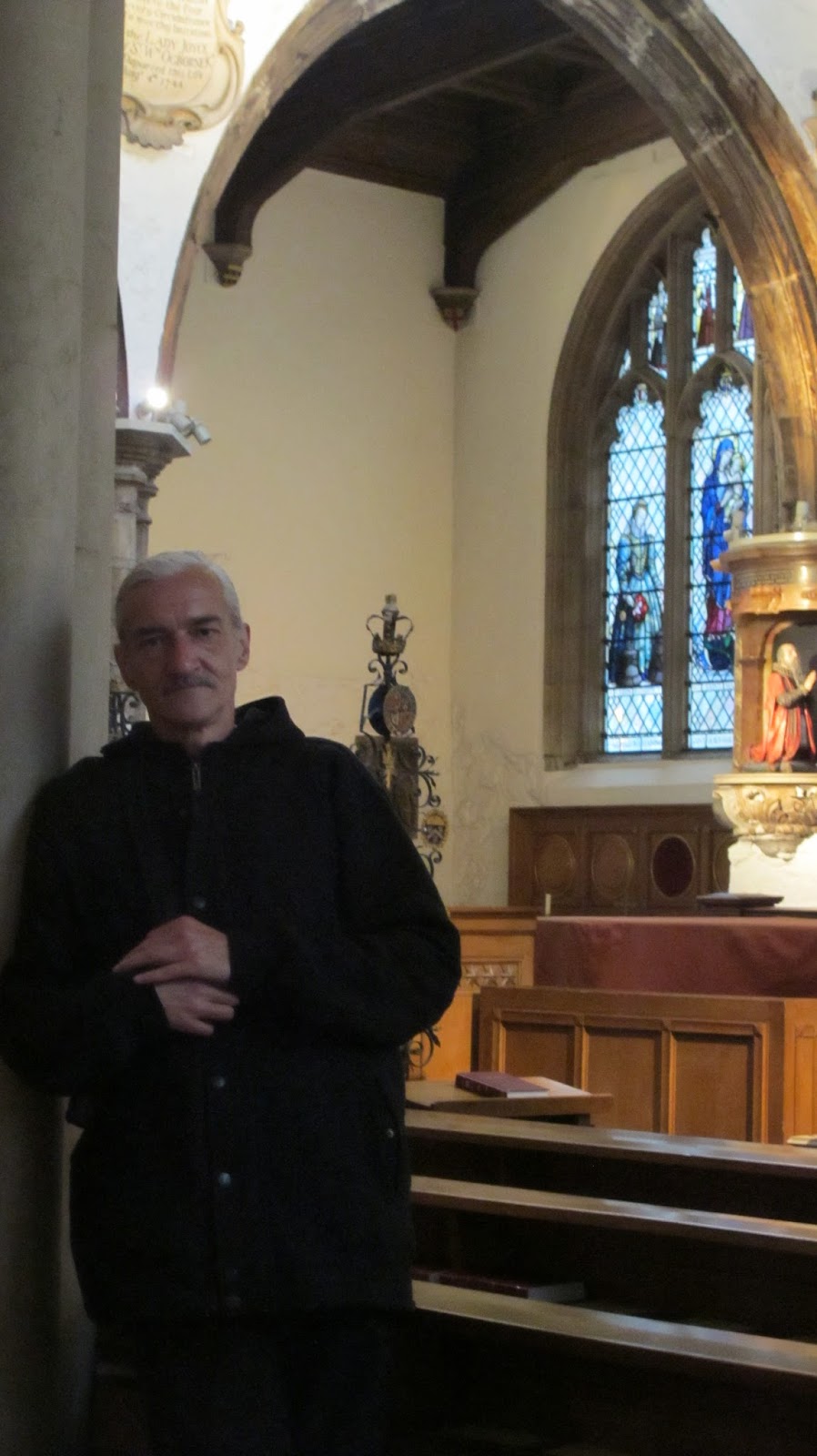
The Fig.8: In a church not far away from the Tower Bridge.
I look like a monk.

Paradoxically, to me The Big Ben (Bang) in London has already been no association connected with the origin of the Universe and its continuous expansion. Which it tolls for? occurs to me. For the UK? Or for the EU? Maybe it has tolled for the whole Europe. The prime minister D. Cameron has initiated a politic and economic suicide of his own country I would say. In the same time his decision to realize the referendum has made both his own country and the rest of the EU unstable extremely.
The Fig.9: This shot was taken from a double-decked bus going through
 a London street in the night time.

While the Universe has been expanding we, people, have been shrinking in smaller separate unites unable to collaborate together in one big unite. The result of the referendum was 52 to 48 percents for to leave the EU. The Brexit supporters won by 4 % only. This outcome has not seemed to me to be too much convincing. Almost a half of the voters has disagreed with the separation from the EU. There has been no one will to leave the EU in the UK. The only 4% decided to vote for this way. Then the only four percents have destabilized the whole Europe. Incredible? Unfortunately, this butterfly effect has been a real fact.

Is the referendum the right way how to make the crucial decisions? To my opinion the UK´s case has showed us nothing good. In short, I would like to have the UK back to the EU again.


The Czech Version

My a zbytek světa
aneb
od Brexitu k Brexitusu
The Fig.10: A strange building resembling a despotic oriental ruler.

Cítím se jako Evropan. Ale po referendu v UK 23. června 2016 se můj pocit, že jsem Evropan, dost smrštil. Čtu-li ve svých pocitech, pak ten text dekóduji jako velikou ztrátu.

Vesmír naštěstí, alespoň podle astronomů, teoretických fyziků a jiných odborníků na vesmír, nadále provádí opačnou práci - rozpíná se. Na rozdíl od smršťující se EU. 28 - 1 = 27.
Mé vědomí o silné a kompaktní EU, jejímž jsem členem, je aktem UK velmi ošklivě zraněno. Měl bych svůj smutek připisovat Angličanům? Proč se EU rozhodli opustit? Jediné, co s tím mohu dělat, je spekulovat o tom. Přesnou odpověď na tuhle otázku neznám. Nezískávám ji ani ze světových masmédií, ani z našich.
The Fig.11: The London´s Eye in the night.

Na první letmý pohled se nestalo nic tak hrozného. Geograficky jsou ostrovy UK pořád tam, kde jsou vždycky, ani se neutopily v moři, ani nebyly odpáleny do kosmu, aby zaujaly pozice na Měsíci či na Marsu. Nic podobného se nestalo.

Avšak ty ostrovy nejsou pusté, jsou obydleny velmi houževnatým národem zvaným Angličané. Jejich historie je bohatá, dlouhá a krvavá a je plná boje o život, o moc, o místo lépe vystavené slunci. Jako ostrované, třebaže jsou součástí Evropy, jsou od zbytku světa odděleni, jak sami sebe rádi definují:"My a zbytek světa".
The Fig.12: In the beginning there was an unnoticeable enter. When we walked
through it we found ourselves in this large open room surrounded with 
pompous Roman faces.

Čím izolovanější ostrovy, tím specifičtější vývoj jejich živáčků včetně člověka. Navíc, a to je další velmi výrazný faktor národa zvaného Angličané, žijete-li na ostrově, musíte se učit čelit živlu, který vás obklopuje ze všech světových stran. Tím přirozeným živlem je moře. A Angličané se mu naučili nejen čelit, ale naučili se ho také využívat. Objevili a zabrali spousty území díky vlastní vynalézavosti, díky velké odvaze, díky touze poznávat nové neprobádané oblasti světa a rovněž díky živlu, jenž jejich rodné ostrovy obklopuje.

A neměl bych zapomenut na další notoricky známé a specifické faktory, jimiž jsou tihle ostrované formováni. Měl bych poukázat na specifický vliv teplého Golfského proudu a na vlhké a mlhavé vnitrozemí se silným vlivem na jejich povahu.
The Fig.13: The Palace of Westminster and the Big Ben (Bang).

Faktory, které jsem uvedl výše, utvářely jejich kulturu. Je tak rozmanitá a silná, že ovliňuje a obohacuje světovou kulturu celého lidstva. Jejich kultura ve všech svých formách  (vědy, umění, sporty, technologické pokroky, filosofie atd.) nepochybně přidává ohromný potenciál ke znalosti lidstva. Angličtina je ve světové komunikaci jazykem číslo jedna. Veškeré anglické kulturní vlivy si získávají zbytek světa povětšinou spontánně, i když v anglické historii nemohu vyloučit některé militantní snahy v zahraničí.

Hrdý Albion však nikdy nezkoušel dobýt tento svět silou, prostě toho byl schopen dosáhnout převážně vlastními kulturními vlivy mírumilovně.
The Fig.14: A view of the Palace of Westminster with the Big Ben (Bang)
to the right.

Ale Angličané nejsou jediným národem žijícím na těchto ostrovech. Spolu s nimi tam spolužijí Skotové, Welshané a Irové. Jejich vzájemné vztahy kolísají s historickým časem. V současnosti se skotské tendence oddělit se od Angličanů zdají nejzřejmější. Navíc je dnešní Stará dobrá Anglie přesycena migranty ze svých dnešních či bývalých kolonií rozptýlených po celém světě. A tak se čistokrevný Angličan stává vzácnější a vzácnější. Čistokrevný Angličan ztrácí své dominantní postavení ve vlastní zemi a také ve světě. Snad proto, že dnešní Angličan už není čistokrevný. Čistokrevný Angličan se rozpouští stejně jako se Keltové rozpustili v genomech jiných evropských národů. Tohle je poslední předsmrtná křeč UK. tohle není Brexit, ale Brexitus.
The Fig.15: The Thames, the Palace of Westminster with the Big Ben (Bang)
 to the left side, the Big Ben (Bang) is almost in the center of this picture.
This shot was taken from one of many bridges going over the river.

Otevřeně tu připouštím, že mé vztahy k UK jsou velmi silné. Můj obdiv a fascinace touto ostrovní zemí započaly už v raném mládí. Tehdy to bylo hlavně prostřednictvím klasické anglické literatury. O pár let později můj pozitivní vztah k této zemi zesílil narůstajícím zájmem o přírodu, kvůli Ch.S. Darwinovi, T.H. Huxleymu (velký Darwinův stoupenec), R. Hookovi (botanik a Darwinův přítel) a mnoha dalším velkým přírodovědcům. Tahle země vždy byla ohromnou líhní vynikajících vědců a není divu, víme-li o nejvyšších úrovních univerzit v Cambridge a v Oxfordu. A poté do mého klukovství přišla šedesátá léta (v roce 1960 mi bylo 5 let) a moje pouta k této zemi navždy potvrdili čtyři hoši z Liverpoolu. Rád bych věděl, kterou z obou alternativ zvolil sir P. McCartney. Rád bych znal odezvu Johna Lennona na referendum (my všichni žijeme ve žluté ponorce.....) či hlas Ringo Stara a v neposlední řadě odezvu George Harrisona na velmi těsné vítězství stoupenců Brexitu. Moc rád bych to věděl, ale dva z těch čtyř už mezi námi nejsou, jo, vím, jsou s námi stále, ale jen jaksi spirituálně.
The Fig.16: Cascades like hyper-modern buildings are one of many new
 dominants alongside Thames the river in London.

Paradoxně, Big Ben (Bang) v Londýně už pro mne není asociací spojenou s původem vesmíru a jeho nepřetržitým rozpínáním. Komu zvoní hranu? napadá mě. UK? Nebo EU? Možná, že zvoní hranu celé Evropě. Řekl bych, že premiér D. Cameron inicioval politickou a ekonomickou sebevraždu vlastní země. Jeho rozhodnutí uskutečnit referendum současně extrémně destabilizovalo jeho zemi i zbytek EU.

Zatímco vesmír se rozpíná, my, lidé, se smršťujeme v menší samostatné jednotky neschopní spolupracovat pohromadě v jedné velké jednotce. Výsledek hlasování byl 52 ku 48 procentům pro opuštění EU. Zastánci Brexitu zvítězili o pouhá 4%. Tento výsledek mi příliš přesvědčivý nepřipadá. Skoro polovina voličů s oddělením od EU nesouhlasila. Opuštění EU v UK není jedné vůle. Pro tuto cestu rozhodla pouhá 4%. Pouhá 4% destabilizují celou Evropu. Neskutečné? Bohužel, tento motýlí efekt je reálný fakt.
The Fig.14: This picture from London is a nice conclusion of this post I think.

Je referendum ten správný způsob, jak dělat podstatná rozhodnutí? Podle mého názoru případ UK nám neukazuje nic dobrého. Zkrátka, rád bych měl UK zase zpět v EU.

České texty k obrázkům:

Obr.1: Komu Big Ben (Bang) zvoní hranu? UK? Nebo EU? Možná zvoní hranu celé Evropě.

Obr.2: Big Ben (Bang) v soumraku.

Obr.3: Tower Bridge.

Obr.4: Pohled na Tower Bridge z Královniny procházky.

Obr.5: Tento velký kovový hák lze spatřit na Královnině procházce.

Obr.6: Pohled na Temži z Tower Bridge.

Obr.7: Na protějším břehu Temže s Tower Bridge za touto historickou pevností.

Obr.8: V jednom kostele nedaleko od Tower Bridge. Vypadám jako nějaký mnich.

Obr.9: Tento snímek byl pořízen z dvoupatrového busu projíždějícího jednou londýnskou ulicí v nočním čase.

Obr.10: Podivná budova připomínající nějakého despotického orientálního vládce.

Obr.11: Oko Londýna v noci.

Obr.12: Na počátku byl nenápadný vchod. Když jsme jím prošli, ocitli jsme se v tomto rozsáhlém otevřeném prostoru obklopeném pompézními římskými fasádami.

Obr.13: Westminsterský palác s Big Benem (Bangem).

Obr.14: Westminsterský  palác s Big Benem (Bangem) vpravo.

Obr.15: Temže, Westminsterský palác s Big Benem (Bangem) nalevo, Big Ben (Bang) je skoro ve středu obrázku.
Snímek byl pořízen z jednoho z mnoha mostů překlenujících Temži.

Obr.16: Kaskádovité hypermoderní stavby jsou jednou z mnoha moderních dominant podél Temže v Londýně.

Obr.17: Myslím, že tento obrázek z Londýna je pěkným závěrem tohoto postu.


čtvrtek 23. června 2016

The English Version

On What My Opinion of The Brexit is:

Hey The UK!
Stay!
Something Says to Me:
This Is The Only Right Way!

I´m listening to The Radio+, the only Czech radio broadcast of the spoken word with no music. It is 19.01 P.M. here in Czech republic. The two hours lasting discussion on the topic of The Brexit was finished just now. Today is Tuesday (06.21. 2016).

On Thursday the 23-th June, i.e. within two days, The people of The Great Britain should decide if their country leave The EU or not.

The debate I have listened to a while before brought nothing new or clear. Nobody can´t say surely how this referendum will finish. Only guesses and speculations and blind estimations. I have nothing better, too.

I don't know any rational and exact facts to prove or to document why the GB should stay or not in the EU. I own a few of instincts only. And a couple of emotions. It may be I own something like the sixth sense, too. And a lot of associations and impressions are teaming up in my brain. And the experience of sixty one years of my life. This is the foundations which I can build my opinion on.

All this say to me: Hey the UK! Stay! I would like you to stay with us in the EU. The EU without you would be like you would be without Scotland, like my country has been without Slovakia, like Serbia has been without Yugoslavia, like..... I know the EU has still been a very young girl to be perfect but to leave her just in her early youth seems to me to be too cruel to her.

Well, I have been finishing this on the Day of your Choice in the morning. It is my personal meaning I have been sending to you from Prague. Yes, I see, it is something like a vain calling from my private Hyde Park. Despite this I want to express my opinion of your Brexit: Please, Vote for our mutual way within the EU!

The Czech Version

O tom, co si myslím o Brexitu:


Hej, Spojené Království!
Zůstaň!
Něco mi říká:
Tohle je jediná správná cesta!

Poslouchám zrovna Rádio +, jedinou českou rozhlasovou stanici mluveného slova bez hudby. Tady v České republice je 19.01 h. večer. Právě teď skončila dvouhodinová debata na téma Brexitu. Dnes je úterý (21.6. 2016).

Ve čtvrtek, 23. června, tzn. za dva dny, by se lidé Velké Británie měli rozhodnout, jestli jejich země opusti EU nebo ne.

Debata, kterou jsem před chvíli poslouchal, nepřinesla nic nového či jasného. Nikdo jistě nedovede říci, jak tohle referendum dopadne. Pouhá tušení a dohady a slepé odhady. Také nemám nic lepšího.

Neznám žádná rozumná a exaktní fakta, abych dokázal nebo doložil, proč by měla GB v EU zůstat či ne. Mám jen několik málo instinktů. A pár emocí. Může být, že též vlastním něco jako šestý smysl. A v mozku se mi spájí spousta asociací a dojmů. A zkušenosti mých jedenašedesáti. Tohle jsou základy na nichž mohu stavět svůj názor.

Vše tohle mi říká: Hej, Spojené Království! Zůstaň! Byl bych rád, abys s námi v EU zůstalo. EU bez Tebe by bylo jako bys Ty bylo bez Skotska, jako moje země je bez Slovenska, jako Srbsko je bez Jugoslávie....... Vím, že EU je na to, aby byla dokonalá, pořád velmi mladá dívka, ale připadá mi, že opustit ji zrovna v jejím raném mládí, je pro ni příliš kruté.

Tohle dokončuji v Den Vaší Volby dopoledne. Je to mé osobní mínění, které Vám posílám z Prahy. Ano, vím, je to cosi jako marné volání z mého privátního Hyde Parku. Vzdor tomu chci svůj názor na váš Brexit vyjádřit: Prosím, volte pro naši společnou cestu v EU!


úterý 21. června 2016

The English Version

On How We Searched for A Rare Orchid
and We Found Another Rare One
The Fig.1: Neottia nidus-avis in flower, Český kras the preserved region, Czech republic.
The photo was taken on 5.29. 2016.

Well, just this was our case in Český Kras the preserved area (Czech republic) stretching out not too far from Prague at the West direction. It was on May the 29-th of this year.

Český kras the region is very large. It includes many interesting places and therefore I should say which of them we decided to visit to within it.
Well, the place where our car was parked named Záhrabská the settlement. The main reason why we went to this settlement drowned in a woody terrain was my long time lasting longing to find Collarorhiza trifida. This unnoticeable and very rare orchid in Bohemia, the Coral Root Orchid in English, grows and does not grow in various separate places in my country.
The Fig.3: A whole view of one plant of N. nidus-avis.

This place was recommended by my friend Adam Majer, the amateur florist you have already known from my often notices in some of my previous posts. He had visited to the place personally a time before and he had succeeded in finding this species there. He described the place of its occurrence to me in such details that not to find the Coral root orchid there seemed to be quite impossible. His description was as follows: "You must go to a bar blocking a path. The path will climb up through a mixed forest to a top of a hill. Climbing the way up you will come to the place where the way will divide into two ones. You will take the left one and you will keep climbing this way up higher and higher. While you will climb it up you will scan its right edge because just in these places I found the orchid. Well, the number of its plants may be variable."
The Fig.3: Flowers of the plant on the Fig.2 in more detail. They seem to be lighter
than with the plant on the Fig.1.

What could you wish more? It seemed that my meeting with the living plants of the Coral root orchid at the first time in my life was more than certain. We followed the Adam´s perfect instructions exactly. But neither a very detailed examination of the right edge of the path nor an examination of its opposite edge gave any positive outcome. Our three pairs of eyes examined the terrain very carefully but the Coral root orchid was nowhere. My two boys began to find the first orchids not far away from the top of the forested hill. But instead of the Coral root orchid this orchid was Cephalanthera damasonium, the same species we had already found in the habit of the White slopes on May the 22-th, i.e. the week before this excursion.
The Fig.4: Often I saw injured flowers of Cephalanthera
damasonium
the orchid. Their creme white was interrupted
by defects of an unknown origin.

Almost we were reaching the top of the hill covered with the mixed forest with a prevalence of leafy trees and our hopes to find the Coral root orchid were decreasing very rapidly. The recommended place we left behind us and our searching became much wider not limited to the right edge of the path only. More often we were leaving the path and we were entering the forest far from it. I was stepping the slope up slowly examining every patch of the ground covered with dead leaves. The dead leaves showed out manifold hues ranging from dark brown and red to light yellow and brown. Besides the hues were changing in color in the varying penetration of the sun rays through tree crowns.

During our climb up to the top of the forested hill we met nobody. The only sounds we could hear came from throats of various invisible birds. It was the morning time. We could see that the forest was saturated with a higher air humidity in that day time. More often we came upon next plants of C. damasonium in various phases of their developments. They were flowering or they were preparing for it. Often I noticed that the flowers (either open or closed) were damaged with yellow brown points or blotches. Their culprits have remained to be unknown to me so far.
The Fig.5: Often we came upon plants of N. nidus-avis in fruit.

On our way up we could observe the more numerous presents of the molluscs (Helix pomatia) and a species of a snail with no conker) of which higher activities were possible to ascribe to the higher humidity in the forest. In one while my vanguard recorded a snake higher above me. The place was nearby the wavy long top of the hill. When I reached the place "the snake" kept waiting for me there. But as soon as I touched my Canon it started creeping so that I could catch a part of its body in the undergrowth only. But a while before its whole portrait was caught by my friend Vendy. Even though I have not his photo it is clear that the small reptile on my photo is the common slow worm.
The Fig.6: An especially fruitful inflorescence of Neottia nidus-avis the orchid. Notice the thick
ribs on the capsules.

The wavy top of the hill became to be the place of my first meeting with the living plants of a strange orchid called Neottia nidus-avis in Latin. I did not suppose this my private discover. It is worth to describe my great moment in a more detailed way I think. My two younger hounds were instructed to search for the Coral root orchid only, they knew Cephalanthera damasonium from our previous field trip to the White slopes already, they saw some portraits of the Coral root orchid on photos but they had no idea of Neottia nidus-avis absolutely. And so it happened that even though they were coming to all new places against us as the first ones this amazing finding had to wait for me.
The Fig.7: The Roman snail (Helix pomatia) is an often
inhabitant in this kingdom of N. nidus-avis the orchid.
This snail likes the higher humidity.

To find the first plant of this orchid species is not so easy ´cause its coloration fuses with its natural surroundings almost perfectly. Growing out of the layer of dead leaves covering the soil under your feet this orchid can be a very good example of the perfect camouflage. I think that my photos of this orchid document this fact with no need of other words.

The flowering plants look like the lamp brushes or so. The green color is absent completely.This orchid has no chlorophyll in its tissues. Its leaves are small and attached tightly to the flowering stem. At the first glance you may think that you are looking at a fading or dying plant so that mostly you turn your eye to any other much more interesting objects quickly without any need to examine "the plant corpse" for a longer fragment of the time. But when my eyes rested on the first plant it did not turn aside and it did not cease gazing at it. Just in that moment I realized fully I was looking at my first Neottia nidus-avis alive!

In the end of my narration I must add that we did not give our hope up to find the Coral root orchid in all the course of our exploration. Unfortunately, this hope turned to be blank. Either it was there and we did not see it or it was not there at all. Also it was possible that we searched for it in wrong places. Nevertheless, despite this failure, I think this field trip to be very successful.


The Czech Version

O tom, jak jsme pátrali po vzácné orchideji
a našli jsme jinou vzácnou
The Fig.8: The Coral root orchid was nowhere but its relative Neottia nidus-avis was everywhere.

Právě tohle byl náš případ v chráněné oblasti Českého krasu (Česká republika), který se rozprostírá nepříliš daleko od Prahy v západním směru. Bylo 29. května letošního roku.
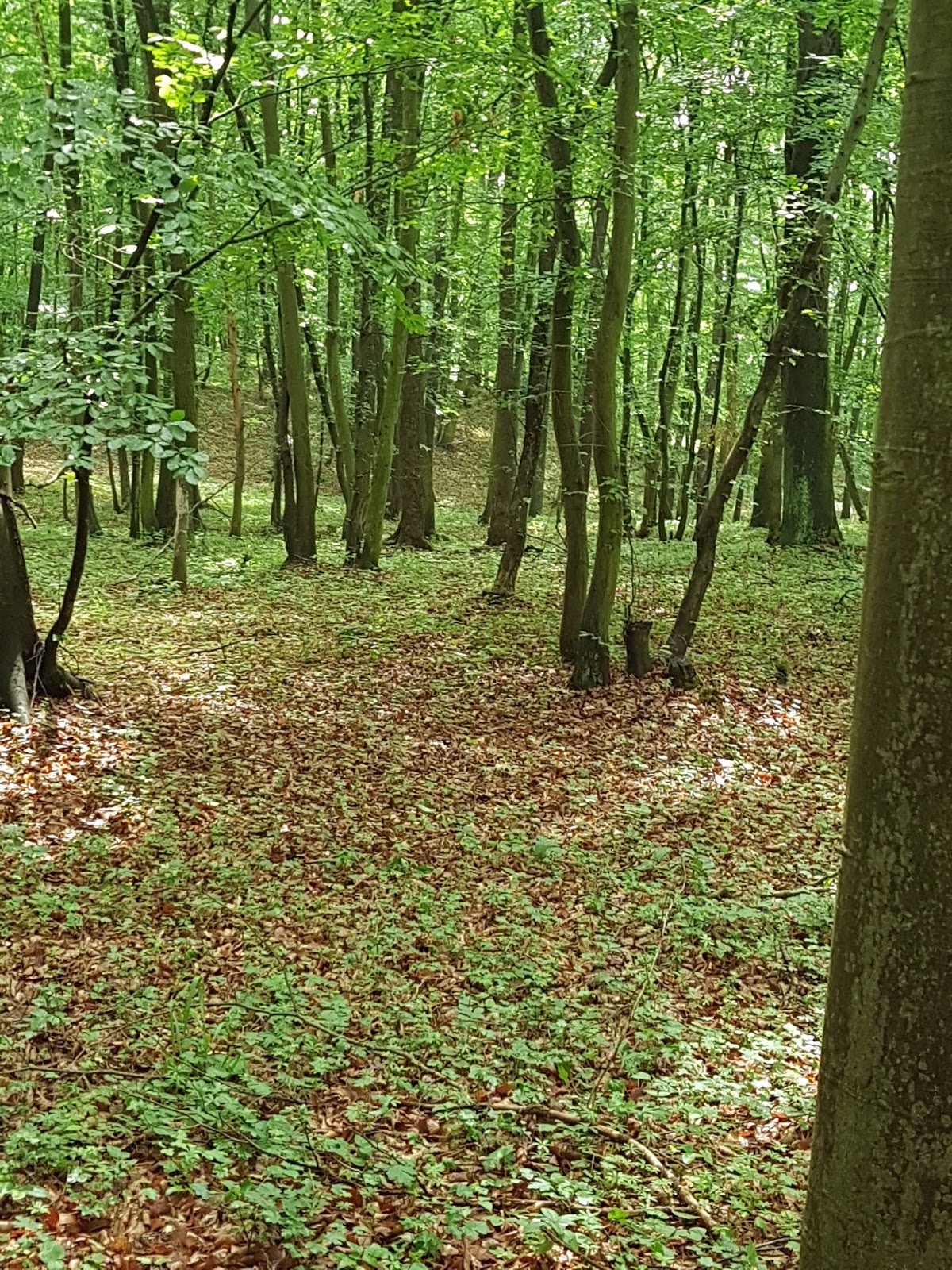
The Fig.9: This leafy forest with the prevalence of the beech (Fagus sylvaticus) is an ideal
surroundings for some species of the orchids. We found two of them and their populations
were quite abundant in this habitat.

Oblast Českého krasu je velmi rozsáhlá. Zahrnuje spoustu zajímavých míst, a proto bych měl sdělit, které z nich jsme se v jeho rozsahu rozhodli navštívit.
Místo, kde bylo zaparkováno auto, se jmenuje osada Záhrabská. Hlavní důvod, proč jsme jeli k této osadě utopené v lesním terénu, byla má dlohodobá touha najít korálici trojklanou (Collarorhiza trifida). Tahle nenápadná a velmi vzácná orchidea, anglicky the Coral root orchid (orchidea s kořeny podobnými mořskému korálu), roste a neroste v Čechách na různých izolovaných místech.
The Fig.10: This snail enjoyed a rotting and moist wood
covered with mosses.

To místo doporučil můj přítel Adam Majer, amatérský florista, kterého už znáte z častých zmínek v některých z mých předešlých postů. Osobně místo před časem navštívil a v nalezení korálice měl úspěch. Popsal místo jejího tamního výskytu tak detailně, že nenajít korálici se zdálo naprosto nemožné. Jeho popis byl následující: "Musíte dojít k zábraně, která blokuje cestu. Cesta bude stoupat smíšeným lesem na vrchol kopce. Při stoupání tou cestou dojdete na místo, kde se cesta rozděluje na dvě. Vydáte se tou levou a budete po ní dál stoupat výš a výš. Zatímco po ní budete stoupat, budete přehlížet její pravý okraj, protože právě v těchto místech jsem tuhle orchidku našel. Počet rostlin může být proměnlivý."

Co byste si mohli přát víc? Zdálo se, že mé setkání s živými korálicemi poprvé v životě je víc než jisté. Adamových perfektních pokynů jsme se drželi přesně. Avšak ani velmi detailní prohlídka pravého okraje cesty, ani prohlídka jejího opačného okraje nedávaly žádný kladný výsledek. Naše tři páry očí zkoumaly terén velmi pečlivě, ale korálice nikde. Moji dva hoši začali nacházet první orchideje nedaleko od vrcholu zalesněného kopce. Ale namísto korálice tahle orchidej byla okrotice bílá (Cephalanthera damasonium), tentýž druh, který jsme už nalezli na lokalitě Bílých strání 22. května, tj, týden před touto exkurzí.
The Fig.11: This was the first photographed plant of N. nidus-avis.

Téměř jsme už dosahovali vrcholu kopce porostlého smíšeným lesem s převahou listnatých stromů a naše naděje najít korálici rychle klesala. Doporučené místo jsme nechali za sebou a naše pátrání se rozšířilo neomezováno pouze na pravý okraj cesty. Častěji jsme ji opouštěli a zacházeli jsme do lesa dál od ní. Zvolna jsem vystupoval svahem a zkoumal každé políčko země pokryté odumřelým listím. Mrtvé listí předvádělo rozmanité odstíny od tmavě hnedočervených po světle žlutohnědé. Navíc ty odstíny měnily barvu v kolísavém průniku slunečních paprsků skrze stromové koruny.
The Fig.12: The place where we left our car. There is the name of the settlement
on the panel: Záhrabská the settlement, St. John under the Rock.

Během výstupu na vrchol zalesněného kopce jsme nikoho nepotkali. Jediné zvuky, které jsme mohli slyšet, pocházely z hrdel rozmanitých neviditelných ptáků. Byl dopolední čas. Častěji jsme naráželi na další rostliny okrotice bílé (C. damasonium) v různých vývojových fázích. Kvetly nebo se na to připravovaly. Často jsem si všímal, že květy jsou poškozeny žlutohnědými puntíky či skvrnami. Jejich pachatelé mi až dosud zůstávají neznámí.

Cestou vzhůru jsme mohli pozorovat mnohem početnější přítomnost měkkýšů (hlemýždě zahradního (Helix pomatia) a nějakého druhu plže bez ulity), jejichž zvýšenou aktivitu bylo možné připsat vyšší vlhkosti v lese. V jedné chvíli můj předvoj zaznamenal výše nade mnou nějakého hada. To místo bylo poblíž zvlněného táhlého vrcholu kopce. Když jsem k místu dospěl, "had" tam na mě nepřestával čekat. Jakmile jsem se ale dotkl Canonu, začal se plazit, takže jsem dokázal zachytit pouze část jeho těla v podrostu. Ale o chvíli dříve jeho celý portrét zachytil přítel Vendy. I když jeho fotografii nemám, je jasné, že ten malý plaz na mé fotce je běžný slepýš křehký.
The Fig.13: There was the kingdom of N. nidus-avis
the orchid behind the bar.

Zvlněný vrchol kopce se stal místem mého prvního setkání s živými rostlinami podivné orchideje nazvané v latině Neottia nidus-avis (hlístník hnízdák). Tenhle svůj soukromý objev jsem nepředpokládal. Myslím, že stojí za to popsat mou velkou chvíli podrobněji. Moji dva mladší ohaři byli instruováni hledat pouze korálici, okrotici bílou (C. damasonium) znali už z předešlého terénního výletu v Bílých stráních, viděli nějaké portréty korálice na fotografiích, ale neměli absolutně žádnou představu o hlístníku hnízdáku (N. nidus-avis). A tak se stalo, že i když přicházeli na všechna nová místa před námi jako první, tenhle úžasný objev musel počkat na mě.

Najít první rostlinu tohoto druhu orchideje není snadné, protože její zbarvení splývá s okolím téměř dokonale. Tahle orchidej, která vyrůstá z vrstvy odumřelého listí pod vašima nohama, může být velice dobrým příkladem dokonalé kamufláže. Myslím, že mé fotografie hlístníku hnízdáku (N. nidus-avis) dokládají tento fakt bez potřeby dalších slov.

Kvetoucí rostliny vypadají jako kartáč na čištění petrolejových lamp či tak podobně. Zelená barva úplně chybí. Listy jsou malé a těsně přitisklé ke květnímu stvolu. Na první pohled si snad můžete myslet, že se právě díváte na vadnoucí či odumírající rostlinu, takže povětšinou rychle odvracíte zrak k jakýmkoliv jiným mnohem zajímavějším objektům bez potřeby zkoumat tu "rostlinnou mrtvolu" delší zlomek času. Když mi však zrak spočinul na na první rostlině, neodvrátil se stranou a nepřestával na ni upřeně civět. Právě v tom momentě jsem si plně uvědomil, že se dívám na svůj první živoucí hlístník hnízdák (Neottia nidus-avis)!
The Fig.14: "The snake" turned to be the slow worm only. See more
in my text.

V závěru vyprávění musím dodat, že jsme se naděje na nález korálice trojklané (Collarorhiza trifida) nevzdávali v celém průběhu průzkumu. Bohužel, tato naděje se ukázala být planou. Buď tam byla a my jsme ji neviděli, nebo tam nebyla vůbec. Také bylo možné, že jsme po ní pátrali na špatných místech. Nicméně, vzdor tomuto nezdaru, pokládám tento terénní výlet za velmi úspěšný.

České popisky k textům pod obrázky:

Obr.1: Hlístník hnízdák (Neottia nidus-avis) v květu, chráněná oblast Český kras, Česká republika. Foto bylo pořízeno 29.5. 2016.

Obr.2: Celkový pohled na jednu rostlinu hlístníku hnízdáku (N. nidus-avis).

Obr.3: Květy rostliny na obr.2 detailněji. Zdají se světlejší než u rostliny na obr.1.

Obr.4: Často jsem viděl poraněné květy u okrotice bílé (Cephalanthera damasonium). Jejich krémově bílou narušovaly defekty neznámého původu.
The Fig.15: A flowering Neottia nidus-avis once again on the bacground of my leg.

Obr.5: Často jsme naráželi na rostliny hlístníku hnízdáku (N. nidus-avis) v plodu.

Obr.6: Zvláště plodné květenství orchideje hlístníku hnízdáku (N. nidus-avis). Povšimněte si silných žeber na tobolkách.

Obr.7: Hlemýžď zahradní (Helix pomatia) je častým obyvatelem v této říši orchideje hlístníku hnízdáku (N. nidus-avis). Vyšší vlhkost má v oblibě.

Obr.8: Korálice nebyla nikde, ale její příbuzný, hlístník hnízdák (Neottia nidus-avis), všude.

Obr.9: Tento listnatý les s převahou buku lesního (Fagus sylvaticus) je ideálním prostředím pro některé druhy orchidejí. Našli jsme dva z nich a jejich populace byly na této lokalitě dosti hojné.

Obr.10: Tenhle plž si užíval tlející a vlhké dřevo porostlé mechy.

Obr.11: Tohle byl první fotografovaný hlístník hnízdák (N. nidus-avis).

Obr.12: Místo, kde jsme zanechali auto. Na tabuli je název osady: Osada Záhrabská, Svatý Jan pod Skalou.

Obr.13: Království hlístníku hnízdáku (N. nidus-avis) bylo za tou závorou.

Obr.14: Ukázalo se, že "had" je jen slepýš. Viz více v mém textu.

Obr.15: Kvetoucí hlístník hnízdák (Neottia nidus-avis) ještě jednou na pozadí mé nohy.


čtvrtek 16. června 2016

The English Version

On The Cherry On My Birthday Cake

The Part Four and Last

The Remarkable Ophrys insectifera Once Again on (prevalently) 
the Background of My Palm and Arm
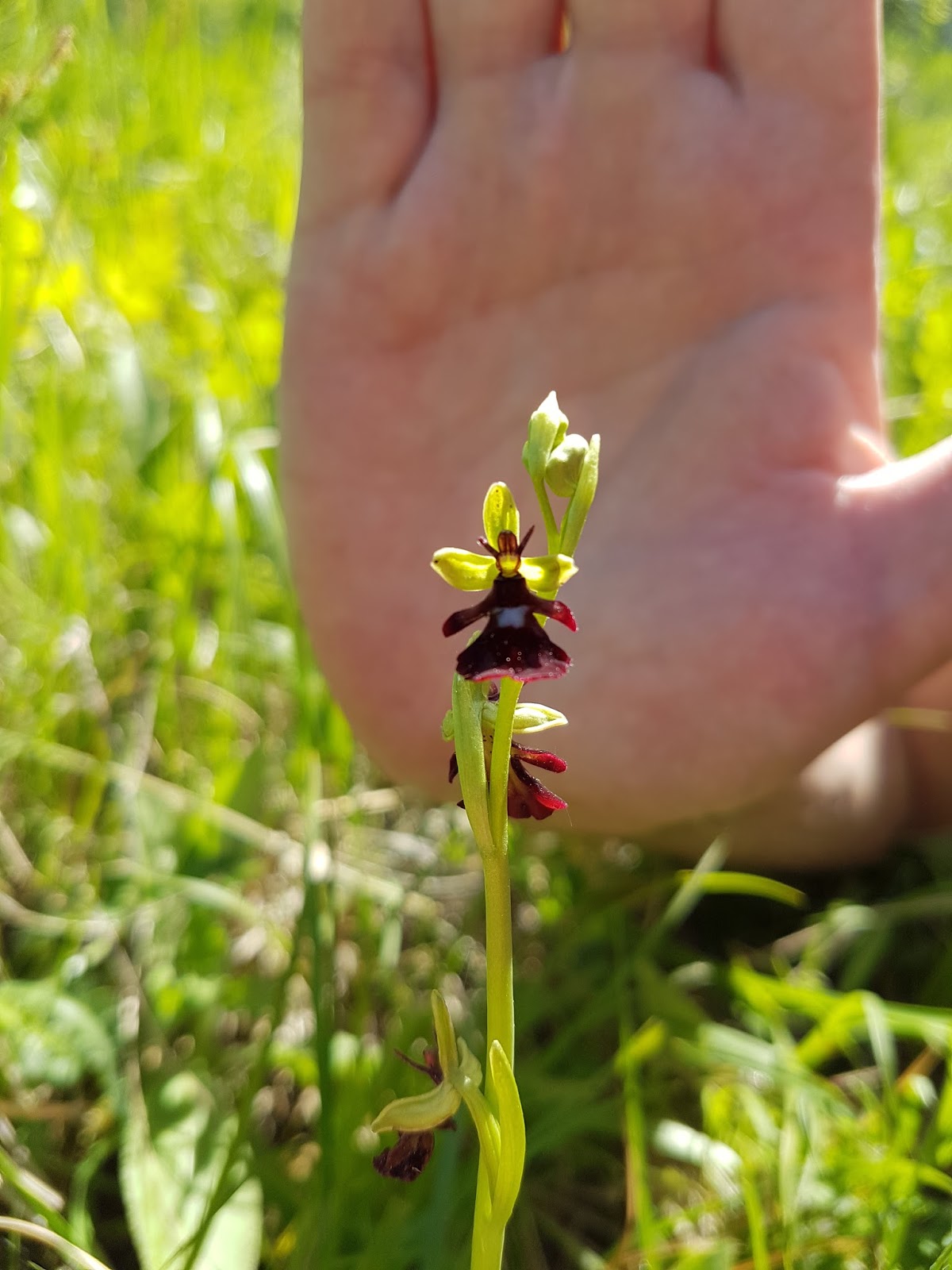
The Fig.1: One flower of Ophrys insectifera on the background of my palm. You can see that
its external tepals are yellow green in color while its three internal tepals form something like a moth
including its velvet wings, its head with antennae and its probe as well. This is why I would say that main
pollinator of the flowers must be some species of a moth rather than any other insect.
 But this is my speculation only.

When we left the shadowy wood our way continued on alongside the steep slope to our right side. The slope was open with a few of trees or bushes growing on it.
There was the highest concentration of Ophrys insectifera we could see in the smaller section.We found several especially beautiful plants of this species there. The most concentration of the plants was at the foot of the slope. There was a narrow path climbing the slope up and when we enjoyed the plants of Ohrys insectifera we took it. The higher we climbed the path up the lesser plants of this species we could observed.
The Fig.2: Three flowering plants of O. insectifera growing together. You can see the spiral
positions of the separate flowers on the axes of the flowering stems. By this way the flowers
show their moth like dummies out at all directions. 

But before than we left the place our magical botanist reappeared. We were examining the plants in more detail, I was photographing them and suddenly he was there again. He was passing by us without stopping and he was calling: "Next plants of Ophrys insectifera? Well, I counted 50 plants of this species already!" and he was away as fast as he appeared a while before.
The Fig.3: Top parts of the three plants of O. insectifera from the fig.2.

The way up was ended up by a next path leading horizontally under the top part of the slopes. We sat on its edge taking rest and viewing of the landscape under us. A while later we started to go back to the car.
We could not explore the whole terrain of the White slopes. We managed to see only one small part of many niches of this beautiful habitat rising up in the middle of the agricultural landscape. A good reason someday to go back there.

As for the orchids we found four species of them in the White slopes. By my estimate the population of Listera ovata was the most numerous of them. According to me the second place belongs to Ophrys insectifera, the third place gets Cephalanthera damasonium and the fourth place belongs to Orchis purpurea. The more robust plants the lesser their numbers. Also all the species grew in lower parts of the slopes or at their feet. If you want to see them and you are standing on a top of such a slope you must step the slope down to them. Top parts of the slopes are not their favorite places. This is my personal observations with this four orchids we found in the White slopes. My rules are derived from my personal observations and they need not be valuable in general but just this was what I observed there.

The Czech Version

O třešni na mém narozeninovém dortě

Část čtvrtá a poslední

Pozoruhodný tořič hmyzonosný (Ophrys insectifera) ještě jednou 
na (převážně) pozadí mé dlaně a paže
The Fig.4: A whole view of the three plants of O. insectifera on their natural background.

Když jsme opustili stinný les, pokračovala naše cesta podél strmé stráně po naší pravé straně. Stráň byla otevřená a rostlo na ní jen pár stromů a keřů. V tomhle menším úseku byla největší koncentrace tořiče hmyzonosného (Ophrys insectifera), kterou jsme mohli vidět. Tam jsme našli několik zvlášť nádherných rostlin tohoto druhu. Největší soustředění rostlin bylo na úpatí svahu. Byla tam úzká pěšina šplhající vzhůru do svahu, a když jsme si rostlin tořiče hmyzonosného (O. insectifera) užili, vydali jsme se po ní. Čím výš jsme pěšinou stoupali, tím menší počet tořičů jsme mohli pozorovat.

Ale dříve než jsme místo opustili, znovu se zjevil náš kouzelný botanik. Zrovna jsme si rostliny prohlíželi podrobněji, já jsem je fotil a nahle tam byl znovu. Procházel kol nás, aniž by zastavil a volal: "Další tořiče? Já jsem jich už napočítal na padesát!" a byl pryč stejně rychle jako se o chvíli dříve objevil.
The Fig.5: The flowers of Ophrys insectifera on the background of my arm evoke a gorget
with specially modified diamonds falling down from my invisible hand.

Cesta vzhůru končila další pěšinou vedoucí horizontálně pod vrcholovou částí svahů. Sedli jsme si na její okraj, abychom si odpočali a hleděli jsme do krajiny pod námi. O chvíli později jsme se vydali zpět k autu. Nemohli jsme prozkoumat celý terén Bílých strání. Zvládli jsme vidět pouhou jednu malou část z mnoha nik této krásné lokality, jež se zvedá uprostřed zemědělské krajiny. Dobrý důvod jednou se tam vrátit.
The Fig.6: The flowers of O. insectifera in more detail.

Pokud jde o orchideje, našli jsme z nich na Bílých stráních čtyři druhy. Podle mého odhadu nejpočetnější byla populace bradáčku vejčitého (Listera ovata). Druhé místo podle mne patří tořiči hmyzonosnému (Ophrys insectifera), třetí místo získává okrotice bílá (Cephalanthera damasonium) a čtvrté místo patří vstavači nachovému (Orchis purpurea). Čím robustnější rostliny, tím menší jejich počet. Tyto rostliny také rostly v nižších částech strání či na jejich úpatích. Chcete-li je vidět a stojíte právě na vrcholu takového svahu, musíte za nimi sestoupit dolů. Horní pasáže svahů nejsou jejich oblíbeným místem. Toto jsou má osobní pozorování a nemusí být platná obecně, ale právě tohle jsem tam pozoroval.
The Fig.7: Our way up from the place of the highest concentration of the O. insectifera
population. Venda, one of my two colleagues, is stepping the path up higher above me. 

Česká verze popisků pod obrázky:

Obr.1: Jeden květ tořiče hmyzonosného (Ophrys insectifera) na pozadí mé dlaně. Vidíte, že jeho vnější okvětní plátky jsou žlutozelené, zatímco jeho vnitřní okvětní plátky (intratepaly) vytvářejí cosi jako můru včetně sametových křídel, hlavy s tykadly a také sosáku. Proto bych řekl, že hlavním oplylovačem těchto květů musí být spíš nějaký druh můry, než jakýkoliv jiný hmyz. Ale je to jen má spekulace.

Obr.2: Tři kvetoucí tořiči hmyzonosní (O. insectifera) rostoucí pohromadě. Vidíte spirální postavení jednotlivých květů na osách květních stvolů. Takto květy vystavují své můří atrapy ve všech směrech.

Obr.3: Vrcholové části tří rostlin tořiče hmyzonosného (O. insectifera) z obr. 2.
The Fig.8: A view of the surrounding landscape from the upper level of the slope
with an abundant occurrence of Ophrys insectifera at its lower level under us.

Obr.4: Celkový pohled na tři rostliny tořiče hmyzonosného (O. insectifera) na přirozeném pozadí.

Obr.5: Květy tořiče hmyzonosného (O. insectifera) na pozadí mé paže evokují řetěz se speciálně upravenými diamanty spadající z mé neviditelné ruky.

Obr.6: Květy tořiče hmyzonosného (O. insectifera) detailněji.

Obr.7: Naše cesta vzhůru od místa nejvyšší koncentrace populace tořiče myzonosného (O. insectifera). Venda, jeden z mých dvou kolegů, stoupá pěšinou výše nade mnou.

Obr.8: Pohled na okolní krajinu z hořejší úrovně svahu s hojným výskytem tořiče hmyzonosného (O. insectifera) v nižší úrovni pod námi.