pondělí 21. listopadu 2016

The English Version

Three Days in Moravian Beskydy The Range


The Fig.1: You can see my two attendants in the first meadow of the complex of Galovské lúky
the habitat. Moravian Beskydy the Range, 6.11. 2016. Taken with my Canon.
Obr.1: Múžete vidět mé dva společníky na první louce komplexu lokality Galovské lúky. Moravské
Beskydy, 11.6. 2016. Pořízeno mým Canonem.

Galovské lúky The Habitat (V)

(11.6. 2016)


The Fig.2: My son Robert is searching for orchids in the meadow. Moravian
Beskydy, 6.11. 2016. Taken with my Canon.
Obr.2: Syn Robert pátrá na louce po orchidejích. Moravské Beskydy, 11.6.
2016. Pořízeno mým Canonem.

The Flashing Meadows

The Fig.3: The meadow was at the same level as the back in one stretch. This
allowed us to see the surrounding landscape behind the back. Moravian Beskydy
the Range, 6.11. 2016. Taken with my Canon.
Obr.3: Louka byla ve stejné úrovni jako hřbet v jednom úseku. To nám umožňovalo
vidět okolní krajinu za hřbetem. Moravské Beskydy, 11.6. 2016. Pořízeno mým Canonem.

A while later we came upon a next habitat. It was an open meadow in a flat terrain under a short slope going down from the back. The sky sent the clouds to other places and the Sun reappeared on its face. Its rays made the meadow brighter and more flashy. The platform was going down in mild waves in front of us and it was becoming steeper to our right side falling down in villi of manifold shapes and deepness up to the boundary of the forest.


The Fig.4: Next view of the surrounding landscape. In places the forest closed
the meadow by its barriers thus forming a labyrinth or a system of separate
meadows. Moravian Beskydy the Range, 6.11. 2016. Taken with my Canon.
Obr.4: Další pohled na okolní krajinu. Místy les uzavíral louku svými barierami 
a tak vytvářel labyrint či soustavu oddělených lučin. Moravské Beskydy, 11.6. 
2016. Pořízeno mým Canonem.


As usually my partners were walking in front of me at a distance of several meters and then they stepped in the heart of the flashing meadows as the first ones. I could hear their exciting calls and voices confirming we reached the right place.

The Fig.5: You can see the barriers of trees and bushes forming the meadow´s
labyrinth. This meadow rested right on the back. Robert and Vendy did not cease
exploring the terrain. Moravian Beskydy the Range, 6.11. 2016. Taken with my Canon.
Obr.5: Můžete vidět bariéry ze stromů a křovin tvořící luční labyrint. Tato louka
spočívala přímo na hřbetě. Robert s Vendou nepřestávají prozkoumávat terén.
Moravské Beskydy, 11.6. 2016. Pořízeno mým Canonem.

My flashing meadows had nothing to do with the US Flashing Meadows connected with the big tennis tournaments. My flashing meadows were the best qualities. Their composition consisted of the finest herbs including fragile species of Poaceae the family. They flashed in the sunshine like oriental carpets decorated with the most precious gems. They played with many hues of colors like feathers of the most exotic parrots what you could imagine in your minds. Their flashing character and freshness were increased by myriads of tiny drops attaching to leaves, stems and spikes of all their plants after the previous hazing. Various pollinators were overflying from one flower to another and for a while I had a very strong impression that I could hear the photosynthetic concert of the meadows.

The Fig.6: Five spikes of Gymnadenia conopsea together. Moravian Beskydy
the Range, 6.11. 2016. Taken with my Canon.
Obr.6: Pět květenství pětiprstky žežulníku (G. conopsea) pohromadě. Moravské
Beskydy, 11.6. 2016. Pořízeno mým Canonem.

The most surprising thing was the amount of some species of the orchids among the other herbs in the meadow. I think that Gymnadenia conopsea formed the densest population what I could see in the course of all our stay at Moravian Beskydy the Range. While I was taking many shots of plants as well as shots of the whole habitat both with my Canon and with my smart phone my partners were reporting their next findings to me. Though they were no botanists the place took a breath to them, too. The amount of several species of Orchidaceae the family was astounding to all of us. Also I did one longer audio-video recording with my smart phone in the first meadow. It was lower in the slope under the back. Again we could see the same species of the orchids. There was no lack of Traunsteinera globosa and of Platanthera bifolia in the meadow´s composition and despite the fact that I had photographed them many times in all the previous habitats I could not resist to their magic and I took shots of them again. Each of the plants was different. If nothing more, even though it can be rather boring to somebody, the pictures has documented their abundant occurrences at my Flashing meadows or at Galovské lúky the habitat in the course of my visit on 6.11. 2016.

The Fig.7: A wider view of an abundant population of Gymnadenia conopsea at the
Galovské lúky the habitat. Moravian Beskydy the Range, 6.11. 2016. Taken with my
Canon.
Obr.7: Širší pohled na hojnou populaci pětiprstky žežulníku (G. conopsea) na
lokalitě Galovské lúky. Moravské Beskydy, 11.6. 2016. Pořízeno mým Canonem.

Our next exploration of the meadows continued on lower in the slopes to our right side. We stepped down up to the very boundary where the meadows and the forest came into the mutual contact. Thus we examined two wider meadow pockets in the slopes and they surprised us with findings of next dense populations both the already known orchids to us and with at least two new species we had not seen till that time.

The Fig.8: This plant was a new discover to us. We saw several stout and beautiful plants at
Galovské lúky the habitat. You can see thick cross lines on the leafy blades. I dare to judge that
it is Dactylorhiza fuchsii subsp. fuchsii. Moravian Beskydy, the Range, Galovské lúky the habitat,
6.11. 2016. Taken with my smart phone.
Obr.8: Tahle rostlina byla pro nás novým objevem. Na lokalitě Galovské lúky jsme viděli několik
statných a krásných rostlin. Můžete vidět tlusté příčné čárky na listových čepelích. Odvažuji se
soudit, že to je prstnatec Fuchsův pravý (Dactylorhiza fuchsii subsp. fuchsii). Moravské Beskydy,
lokalita Galovské lúky, 11.6. 2016. Pořízeno mým chytrým mobilem.

The Fig:9: Dactylorhiza fuchsii subsp. fuchsii, the closer view of its spike. Galovské lúky the
habitat, Moravian Beskydy the Range, 6.11. 2016. Taken with my smart phone.
Obr.9: Prstnatec Fuchsův pravý (D.f. subsp. fuchsii), bližší pohled na květenství. Galovské lúky,
Moravské Beskydy, 11.6. 2016. Pořízeno mým chytrým mobilem.

The Fig.10: Dactylorhiza fuchsii subsp. fuchsii, flowers at the closer view. Galovské lúky the
habitat, Moravian Beskydy the Range, 6.11. 2016. Taken with my smart phone.
Obr.10: Prstnatec Fuchsův pravý (D.f. subsp. fuchsii), květy v detailnějším pohledu. Galovské
lúky, Moravské Beskydy, 11.6. 2016. Pořízeno mým chytrým mobilem.

The Fig.11: The beauty of flowers of D.f. subsp. fuchsii on yet one picture. You can see that
each flower of the spike has its own specific pattern on its labium. The pattern keeps its basic
form but it changes itself in details from one flower to another. It means that each flower in one
spike is unique. Galovské lúky the habitat, Moravian Beskydy the Range, 6.11. 2016. Taken with
my smart phone.
Obr.11: Krása květů prstnatce Fuchsova pravého (D.f. subsp. fuchsii) na ještě jednom obrázku.
Můžete vidět, že každý květ květenství má na pysku svůj vlastní specifický vzor. Vzor zachovává
základní formu, ale v detailech se mění z jednoho květu na druhý. To znamená, že každý květ v
jednom květenství je jedinečný. Lokalita Galovské lúky, Moravské Beskydy, 11.6. 2016. Pořízeno
mým chytrým mobilem.

The fig.12: The foliage of D.f. subsp. fuchsii. One would like to know if the cross streaks has some
purpose for the plant. Galovské lúky the habitat, Moravian Beskydy the Range, 6.11. 2016. Taken
with my smart phone.
Obr.12: Olistění prstnatce Fuchsova pravého (D.f. subsp. fuchsii). Lokalita Galovské lúky, Moravské
Beskydy, 11.6. 2016. Pořízeno mým chytrým mobilem.

The Fig.13: A whole plant of D.f. subsp. fuchsii. Galovské lúky the habitat, Moravian Beskydy
the Range, 6.11. 2016. Taken with mu smart phone.
Obr.13: Celá rostlina prstnatce Fuchsova pravého (D.f. subsp. fuchsii). Lokalita Galovské
lúky, Moravské Beskydy, 11.6. 2016. Pořízeno mým chytrým mobilem.

The exploration was very intensive because the last meant habitats were very abundant in the occurrence of Orchidaceae the family. The exploration of the slanted meadows was done in the up and down style. Our feet in casuals were soaked with humidity already due to the continuous motion in the wet terrain but we did not care of it. There was a field path above the two meadow pockets. When we examined the first of them we had to climbed up to the path again because the forest stepped up to it. Then we passed by a sylvan stretch to the right and then we started climbing the second meadow down again. In the course of this phase of our exploration often we were at the lowest levels under the back of the mountain we had ever reached till that time. When we finished examining the second slanted meadow we climbed up to the field path again and we took a rest at its margin. There was the second steep meadow above the path. It was stretching up to the back.

The Fig.14: This finding has remained to be a mystery to me so far. I have not able to identify it
with no orchid presented on the pictures of various botanic sources. At the extreme variability of
the orchids it is not easy to determine any species exactly. Galovské lúky the habitat, Moravian
Beskydy the Range, 6.11. 2016. Taken with my smart phone.
Obr.14: Tento nález pro mne až dosud zůstává záhadou. Nejsem schopen ztotožnit ji s žádnou
orchideou uváděnou v různých botanických zdrojích. Při nesmírné proměnlivosti orchidejí není
snadné určit některé druhy přesně. Lokalita Galovské lúky, Moravské Beskydy, 11.6. 2016. Pořízeno
mým chytrým mobilem. 

As I could observe the densest concentrations of the orchids were in the lower parts or stretches of the meadows. The lower we climbed them down the more often we found the orchids. In the composition of the two last meadow we were exploring we found several stout plants of Listera ovata the orchid. It was our first and last finding of this species in Moravian Beskydy the Range. A time before I could observe this species at The White Slopes habitat as my regular readers might know from the posts devoted to this amazing locality. At Galovské lúky the habitat I could see plants of this species with their spikes beaten because they were overweight with humidity. But if the finding of L. ovata said something to us it was the fact that it belonged to the orchid composition of Galovské lúky the habitat. It was no new species to us, it was an old-new species to us.

The Fig.15: A detailed view of flowers of my mysterious orchid.Galovské lúky the habitat, Moravské
Beskydy the Range, 6.11. 2016. Taken with my smart phone.
Obr.15: Detailní pohled na květy mé záhadné orchideje. Lokalita Galovské lúky, Moravské Beskydy,
11.6. 2016. Pořízeno mým chytrým mobilem.

Three quite new findings deserve a longer narration or a more detailed paragraph. It was a great conclusion of the whole exploration of Galovské lúky the habitat, a fantastic finish of all our efforts invested in the last trip in Moravian Beskydy the Range.
1/ This quite new discover to us you can see on the fig.8 up to 13. It was Robert who found it at the first time in the lowest part of the first meadow. Also it occurred in the lowest part of the second meadow. The slanted foot of the first meadow at the margin of the forest was covered with sylvan and bushy islets dispersed throughout its slanted surface so that semi shadowy places were alternating with sunny and open places. This plant preferred the semi shadowy places rather than the open places. We observed no dense populations of this plant. There were a few of the plants in places growing not too far from each other.
2/ The second finding quite new to us you can see on fig.14 up to 18. Here I am not able to decide whom I should ascribe this finding to. But one thing is sure. I noticed the marked differences of this plant myself and therefore I took some shots of it. As you can see yourselves the flowers are white with a pale violet hue on rims of the tepals of which this hue is the darkest on the helmet. The spur is wider and short. As long as I recall well I observed no numerous populations of this orchid. The plant was found in the first meadow among the other much more numerous orchids. It occurred in a very sporadic way among the other plants and I did not search for next similar plants purposefully.

The Fig.16: To think this plant to be a new species would be very assertive. To my opinion the most
probable hypothesis is that this mysterious pale orchid is a hybrid, maybe a hybrid between two
separate subspecies. And both the subspecies grew together at one habitat. Galovské lúky the habitat,
Moravian Beskydy, 6.11. 2016. Taken with my smart phone.
Obr.16: Považovat tuhle rostlinu za nový druh by bylo velmi troufalé. Podle mého názoru nejpravděpodobnější
hypotézou je, že tahle tajemná bledá orchidej je kříženec, možná kříženec mezi dvěma samostatnými
poddruhy. A oba ty poddruhy rostou pospolu na jedné lokalitě. Lokalita Galovské lúky, Moravské Beskydy,
11.6. 2016. Pořízeno mým chytrým mobilem.

3/ The third discover was no new species but a rare curiosity. It was discovered by Robert in the meadow above the path where we were taking a rest. While me and Vendy were sitting and talking at the edge of the path Robert was examining the meadow above the path. He was wading through its vegetation cover a few of meters above us. Suddenly we heard his voice: "Zdenku, here is a clear albino of Traunsteinera globosa, all its flowers are completely white in color!" I jumped up on my feet immediately and I covered the short distance between me and Robert with the lightening velocity. Yes, it was as Robert reported to me a while before. I looked at the albino of T. globosa. Maybe you have already known the following. Yes, you are right. Then my smart phone was in turn. And I would say that it did a very good job.

When the photographing the albino was finished we climbed the meadow up to the back. We stood up on a next path. We followed it till we reached the point of our previous climb up and then by the road off style we undertook a quick climb the slope down. As we were stepping the terrain where Robert had found the dying fawn down at a good tempo my two boys under me were warning me to be careful because an animal was lying rightly in my way. But still I did not see nothing in the wild undergrowth running under my feet. And then suddenly the seemingly dying animal jumped up tightly before me and it was rushing away to the left side across the slope so quickly that to use my Canon or the smart phone was impossible. Well then, the story of the dying fawn had a happy end. A couple of minutes later we arrived at the car. We returned to our hotel in Karolínka the settlement, we took a substantial supper and yet the same evening we left for Prague.

The Czech Version

Tři dny v Moravských Beskydech


The Fig.17: The flowering orchid on the picture is Platanthera bifolia. There is a next flowering
plant to the right but its contours are fuzzy. Maybe it is not the second P. bifolia but the second
plant of my mysterious pale orchid of which spike I caught on the fig.18. Galovské lúky the habitat,
Moravian Beskydy the Range, 6.11. 2016. Taken with my smart phone.
Obr.17: Kvetoucí orchidea na obrázku je vemeník dvoulistý (Platanthera bifolia). Napravo je další
kvetoucí rostlina, ale její obrysy jsou rozmazané. Možná to není druhý vemeník, ale druhá rostlina
mé tajemné bledé orchideje, jejíž květenství jsem zachytil na obr.18. Lokalita Galovské lúky,
Moravské Beskydy, 11.6. 2016. Pořízeno mým chytrým mobilem.

The Fig.18: The second and last plant of my mysterious pale orchid. Here I took a shot of its spike.
Of course, also this mystery could be a form or a variety either of Dactylorhiza fuchsii subsp. fuchsii
or of Gymnadenia conopsea subsp. conopsea. Or the orchid may be afflicted by a genetic deviation
connected with a lack of its pigments. Galovské lúky the habitat, Moravian Beskydy the Range, 6.11.
2016. Taken with my smart phone.
Obr.18: Druhá a poslední rostlina mé tajemné bledé orchideje. Zde jsem pořídil záběr jejího květenství.
Samozřejmě, že tahle záhada by také mohla být nějakou formou či varietou buď prstnatce Fuchsova
pravého (D.f. subsp. fuchsii) nebo pětiprstky žežulníku pravé (G.c. subsp. conopsea). Nebo ta orchidea
může být postižena nějakou genetickou odchylkou spojenou s nedostatkem pigmentů. Lokalita Galovské
lúky, Moravské Beskydy, 11.6. 2016. Pořízeno mým chytrým mobilem.


Galovské lúky (V)

(6.11. 2016)

Flashing meadows (Třpytivé louky)


The Fig.19: A jungle of flowers in a spike of Platanthera bifolia at the closer view. Galovské lúky
the habitat, Moravian Beskydy the Range, 6.11. 2016. Taken with my smart phone.
Obr.19: Prales květů v květenství vemeníku dvoulistého (P. bifolia) v bližším pohledu. Lokalita
Galovské lúky, Moravské Beskydy, 11.6. 2016. Pořízeno mým chytrým mobilem.

O chvíli později jsme narazili na další lokalitu. Byla to otevřená louka v plochém terénu pod krátkým svahem, který se svažoval od hřbetu. Obloha poslala mraky na jiná místa a na její tváři se opět objevilo slunce. Jeho paprsky způsobovaly, že louka byla zářivější a třpytivější. Plošina spadala v mírných vlnách před námi a po naší pravé straně strměla dolů v klcích rozmanitých tvarů a hloubky až po hranici lesa.

The Fig.20: A beaten spike of Listera ovata. Also this orchid grew at Galovské lúky the habitat.
Moravian Beskydy the Range, 6.11. 2016. Taken with my smart phone.
Obr.20: Polehlé květenství bradáčku vejčitého (Listera ovata). Také tato orchidea rostla na lokalitě
Galovské lúky. Moravské Beskydy, 11.6. 2016. Pořízeno mým chytrým mobilem.

The Fig.21: Some spikes of L. ovata tended bending themselves down. Galovské
lúky the habitat, Moravian Beskydy, 6.11. 2016. Taken with my smart phone.
Obr.21: Některá květenství bradáčku vejčitého (L. ovata) měla sklon
ohýbat se. Lokalita Galovské lúky, Moravské Beskydy, 11.6. 2016. Pořízeno mým 
chytrým mobilem.

The Fig.22: Two plants of Listera ovata the orchid. The flowering plant´s left leaf is faded away.
The non flowering plant of the same species behind the first one has a lower part of its spike only.
Despite of their injures both the plants seem to be full of vitality. Galovské lúky the habitat, Moravian
Beskydy the Range, 6.11. 2016. Taken with my smart phone.
Obr.22: Dvě rostliny bradáčku vejčitého (L. ovata). Levý list kvetoucí rostliny je zvadlý. Nekvetoucí
rostlina téhož druhu za první má pouze dolní část květenství.Vzdor jejich poraněním se zdá, že obě
rostliny jsou plné životnosti. Lokalita Galovské lúky, Moravské Beskydy, 11.6. 2016. Pořízeno mým
chytrým mobilem.

Moji parťáci šli jako obvykle přede mnou ve vzdálenosti několika metrů, a tudíž vstoupili do srdce třytivých lučin jako první. Mohl jsem slyšet jejich vzrušená zvolání a hlasy, jež potvrzovaly, že jsme dosáhly pravého místa.

The Fig.23: Numerous yellow green spikes of Listera ovata are fusing with various hues of the
other green in this slanted meadow. Unlike them two little pale pink heads of Traunsteinera globosa
are towering above the surrounding vegetation. Galovské lúky the habitat, Moravian Beskydy the Range,
6.11. 2016. Taken with my smart phone.
Obr.23: Početná žlutozelená květenství bradáčku vejčitého (L. ovata) splývají s různými odstíny zeleně
ve svažité louce. Na rozdíl od nich dvě narůžovělé hlavinky hlavinky horské (T. globosa) vynikají nad
okolní vegetací. Lokalita Galovské lúky, Moravské Beskydy, 11.6. 2016. Pořízeno mým chytrým mobilem.

The Fig.24: Traunsteinera globosa is a rare ingredient in the meadows of Moravian Beskydy the
Range. Galovské lúky the habitat. 6.11. 2016. Taken with my smart phone.
Obr.24: Hlavinka horská (T. globosa) je vzácnou přísadou v loukách Moravských Beskyd. Lokalita
Galovské lúky. 11.6. 2016. Pořízeno mým chytrým mobilem.

The Fig.25: Traunsteinera globosa is a specious orchid. Its minute flowers are accumulated in a
semi rounded terminal spike pretending one big flower. Galovské lúky the habitat. Moravian Beskydy
the Range, 6.11. 2016. Taken with my smart phone.
Obr.25: Hlavinka horská (T. globosa) je šálivá orchidea. Její drobné květy jsou nahromaděny v
polokulovitém vrcholovém květenství předstírajícím jeden velký květ. Lokalita Galovské lúky, Moravské
Beskydy, 11.6. 2016. Pořízeno mým chytrým mobilem.

Mé třpytivé louky (flashing meadows) neměly nic společného s americkými Flashing meadows spojenými s velkými tenisovými kláními. Mé třpytivé louky byly nejlepší kvality. Jejich skladba sestávala z nejjemnějších bylin včetně křehkých druhů z čeledi lipnicovitých (Poaceae). Třpytily se ve sluneční záři jako orientální koberce zdobené nejdrahocennějšími šperky. Hrály mnoha odstíny barev jako opeření těch nejexotičtějších papoušků, jaké si v mysli umíte představit. Jejich třpytivý charakter a svěžest zvyšovaly myriády kapiček lnoucích k listům, stonkům a květenstvím všech jejich rostlin po předchozím mrholení. Z květu na květ přeletovali různí opylovači a já měl na okamžik dojem, že dokážu slyšet fotosyntetický koncert těch luk.

The Fig.26: A great point behind our hunting for the orchids in Moravian Beskydy the Range was
Robert´s finding of this albino form of Traunsteinera globosa. This plant´s terminal "big and tall
hemisphere" (compare it with almost "flat little head" on the previous picture) was formed by quite
white flowers. Galovské lúky the habitat. Moravian Beskydy the Range. 6.11. 2016. Taken with my
smart phone.
Obr.26: Báječnou tečkou za naším lovem orchidejí v Moravských Beskydech byl Robertův nález této
albinotické formy hlavinky horské (T. globosa). "Koncová velká a vysoká polokoule" (srovnej ji s
téměř "plochou hlavinkou" na předešlém obrázku) téhle rostliny byla tvořena zcela bílými květy. Lokalita
Galovské lúky. Moravské Beskydy, 11.6. 2016. Pořízeno mým chytrým mobilem.

Nejpřekvapivější bylo množství některých druhů orchidejí mezi ostatními bylinami na louce. Myslím, že pětiprstka žežulník (Gymnadenia conopsea) vytvářela nejhustší populaci, jakou jsem mohl vidět v průběhu celého našeho pobytu v Moravských Beskydech. Zatímco jsem pořizoval mnoho snímků rostlin a také snímků celé lokality Canonem i chytrým mobilem, moji parťáci mi oznamovali svoje další nálezy. Ačkoliv nejsou žádní botanici, to místo jim rovněž vzalo dech. To množství několika druhů z čeledi vstavačovitých (Orchidaceae) bylo ohromující pro nás pro všechny. Na první louce jsem také udělal jeden delší audio-video záznam chytrým mobilem. Bylo to níže ve svahu pod hřbetem. Opět jsme mohli vidět stejné druhy orchidejí. V luční skladbě nebyla nouze o hlavinku horskou (Traunsteinera globosa) a o vemeník dvoulistý (Platanthera bifolia) a přesto, že jsem je mnohokrát fotografoval na předešlých lokalitách, nedokázal jsem vzdorovat jejich kouzlu a fotil jsem je znovu. Každá z těch rostlin byla jiná. Když nic víc, i když to může být pro někoho poněkud nudné, ty obrázky dokládají jejich hojný výskyt na mých Třpytivých loukách či na lokalitě Galovské lúky v průběhu mé návštěvy 11.6. 2016.

The Fig.27: Traunsteinera globosa the albino, its terminal spike at the closer view. The lowest
flowers began turning brown at rims of their tepals. Galovské lúky the habitat, Moravian Beskydy
the Range, 6.11. 2016. Taken with my smart phone.
Obr.27: Hlavinka horská (T. globosa), albín, její terminální květenství v bližším pohledu. Nejspodnější
květy začínaly na okrajích tepalů hnědnout. Lokalita Galovské lúky, Moravské Beskydy, 11.6. 2016.
Pořízeno mým chytrým mobilem.

Náš průzkum lučin pokračoval níže ve svazích po naší pravé straně. Sestoupili jsme dolů až na samou hranici, kde se louky s lesem dostávaly do vzájemného kontaktu. Takto jsme v těch stráních prozkoumali dvě širší luční kapsy a ony nás překvapily nálezy dalších hustých populací jak orchidejí nám již známých, tak nejméně dvěma druhy, které jsme do té doby neviděli.

The Fig.28: My probe approached to the graceful white planet called Traunsteinera globosa and
 it started orbiting it at the point of its maximal approach taking shots of its surface. Believe me or
not it happened at Galovské lúky the habitat, Moravian Beskydy the Range, 6.11. 2016. The probe
consisted of two modules: of me and my smart phone.
Obr.28: Moje sonda se přiblížila k půvabné bílé planetě zvané hlavinka horská (T. globosa) a v bodě
maximálního přiblížení ji počala obíhat a současně pořizovat snímky jejího povrchu. Věřte mi či 
nevěřte, ale událo se to na lokalitě Galovské lúky, Moravské Beskydy, 11.6. 2016. Sonda sestávala
ze dvou modulů: ze mne a mého chytrého mobilu.


Průzkum byl velice intenzivní, protože posledně zmíněné lokality byly velmi bohaté na výskyt vstavačovitých (Orchidaceae). Průzkum těch svažitých lučin byl prováděn ve stylu nahoru a dolů. Nohy v teniskách jsme už měli nasáklé vlhkostí vzhledem k neustálému pohybu v mokrém terénu, ale nedbali jsme na to. Nad oběma lučními kapsami byla polní cesta. Po průzkumu první z nich jsme museli vyšplhat zase až k cestě, protože les vystupoval až k ní. Poté jsme prošli kol lesního úseku vpravo a začali jsme sestupovat zase druhou loukou. V průběhu této fáze průzkumu jsme často byli v nejnižších úrovních pod hřbetem hory, jakých jsme do té doby dosáhli. Když jsme skončili prohlídku druhé svažité louky, znovu jsme se vyšplhali k cestě a odpočali si na jejím okraji. Nad cestou byla druhá strmá louka. Prostírala se vzhůru ke hřbetu.

The Fig.29: On its orbit my probe recorded a lot of a telescope like objects covering all the planet´s
surface. The mouths of the "telescopes" have been aiming at the outer cosmos. If it is a sign of an
intelligent life or not will show next intensive research. Galovské lúky the habitat, Moravian Beskydy
the Range, 6.11. 2016. Taken with my smart phone.
Obr.29: Moje sonda zaznamenala na své oběžné dráze spoustu teleskopických objektů pokrývajících
veškerý planetární povrch. Ústí těchto "teleskopů" míří do vnějšího kosmu. Je-li to známka inteligentního
života nebo ne, ukáže další intenzivní výzkum. Lokalita Galovské lúky, Moravské Beskydy, 11.6. 2016.
Pořízeno mým chytrým mobilem.


Jak jsem mohl pozorovat, nejhustší koncentrace orchidejí byly v nižších částech či úsecích lučin. Čím níže jsme jimi sestupovali, tím častěji jsme nacházeli orchideje. Ve skladbě posledních dvou lučin, které jsme prozkoumávali, jsme našli několik statných rostlin bradáčku vejčitého (Listera ovata). Tohle byl náš první a poslední nález tohoto druhu v Moravských Beskydech. Před nějakým časem jsem tento druh mohl pozorovat na lokalitě Bílé stráně, jak by snad moji pravidelní čtenáři mohli vědět z postů věnovaných téhle úžasné lokalitě. Na Galovských lúkách jsem viděl rostliny tohoto druhu s květenstvími polehlými, protože byla přetížena vlhkostí. Avšak, pokud nám nalezení bradáčku vejčitého (L. ovata) něco říkalo, byl to fakt, že patří do orchidejové skladby Galovských lúk. Nebyl to pro nás nový druh, byl to pro nás druh staronový.

The Fig.30: Really, this enlarged sample of the hemispherical spike of Traunsteinera globosa the
albino might resemble a strange surface of a distant planet taken by a Mariner or a Voyager. It
was like to find a clover with four leaflets. Galovské lúky the habitat, Moravian Beskydy the Range,
6.11. 2016. Taken with my smart phone.
Obr.30: Opravdu, tento zvětšený vzorek hemisférického květenství albínky hlavinky horské
(T. globosa) by snad mohl připomínat zvláštná povrch vzdálené planety pořízený nějakým Marinerem
či Voyagerem. Bylo to jako najít jetel se čtyřmi lístky. Lokalita Galovské lúky, Moravské Beskydy,
11.6. 2016. Pořízeno mým chytrým mobilem.

Tři zcela nové nálezy si zasluhují delší vyprávění či podrobnější odstavec. Byl to báječný závěr celého průzkumu Galovských lúk, fantastický finiš veškerého našeho usilí vloženého do posledního výletu v Moravských Beskydech.
1/ Tento pro nás zcela nový objev můžete vidět na obr.8 - 13. Byl to Robert, který ho našel v nejnižší části první louky poprvé. Svažité úpatí první louky na okraji lesa bylo porostlé lesnatými a křovitými ostrůvky rozptýlenými po celém kosém povrchu, takže se zpola stinná místa prostřídávala s místy slunečnými a otevřenými. Žádné husté populace této rostliny jsme nepozorovali. Vyskytovalo se tam místy pár rostlin rostoucích nepříliš daleko od sebe.
2/ Druhý nález zcela nový pro nás můžete vidět na obr.14 až 18. Zde si nejsem jistý, komu bych měl tento objev přisoudit. Avšak jedno je jisté. Sám jsem si nápadných rozdílů rostliny povšimnul, a tudíž jsem udělal nějaké její snímky. Jak můžete sami vidět, květy jsou bílé s bledavě fialovým odstínem na okrajích tepalů, z nichž je tento odstín nejtmavší na přílbě. Ostruha je širší a krátká. Pokud si vzpomínám dobře, žádné početné populace téhle orchidky jsem nepozoroval. Rostlina byla nalezena na první louce mezi ostatními mnohem početnějšími orchidejemi. Mezi ostatními rostlinami se vyskytovala velice ojediněle a po dalších podobných rostlinách jsem cíleně nepátral.


The Fig.31: Traunsteinera globosa the albino, its lower part of the stem with leaves. Galovské lúky
the habitat, Moravian Beskydy the Range, 6.11. 2016. Taken with my smart phone.
Obr.31: Hlavinka horská (T. globosa) - albín, její spodní část s listy. Lokalita Galovské lúky, Moravské
Beskydy, 11.6. 2016. Pořízeno mým chytrým mobilem. 

3/ Třetí objev nebyl nový druh, ale vzácná kuriozita. Objevil ji Robert nad cestou, kde jsme odpočívali. Zatímco jsme já a Venda seděli a rozmlouvali při okraji cesty, Robert prohlížel louku nad cestou. Brouzdal vegetačním krytem pár metrů nad námi. Pojednou jsme zaslechli jeho hlas: "Zdenku, tady je čistý albín hlavinky! Všechny její květy jsou úplně bílé!" Okamžitě jsem vyskočil na nohy a urazil tu krátkou vzdálenost mezi mnou a Robertem bleskovou rychlostí. Ano, bylo to, jak mi Robert před chvilkou hlásil. Díval jsem se na albína hlavinky horské (Traunsteinera globosa). Možná už víte následující. Ano, máte pravdu. Pak byl na řadě můj chytrý mobil. A řekl bych, že odvedl velmi dobrou práci.

The Fig.32: A view of the spherical spike of Traunsteinera globosa the albino from above. Galovské
lúky the habitat, Moravian Beskydy the Range, 6.11. 2016. Taken with my smart phone.
Obr.32: Pohled na sférické květenství albinotické hlavinky horské (T. globosa) shora. Lokalita Galovské
lúky, Moravské Beskydy, 11.6. 2016. Pořízeno mým chytrým mobilem.

Když fotografování albínky skončilo, vyšplhali jsme loukou na hřbet. Stanuli jsme na další cestě. Šli jsme po ní, dokud jsme nedosáhli bodu našeho předešlého výstupu a poté jsme road off stylem podstoupili rychlý sestup svahem. Když jsme právě sestupovali terénem, kde Robert našel umírajícího koloucha, oba dva hoši pode mnou mne varovali, abych byl opatrný, protože mi přímo v cestě leží nějaké zvíře. Ale já v tom bujném podrostu, který mi ubíhal pod nohama, pořád nic neviděl. A pak náhle zdánlivě umírající zvíře vyskočilo těsně přede mnou a pádilo pryč vlevo napříč svahem tak rychle, že použít Canon či chytrý mobil bylo nemožné. Takže, historka s umírajícím kolouchem měla šťastný konec. O pár minut později jsme dorazili k autu. Vrátili jsme se do hotelu v osadě Karolínka, vydatně jsme povečeřeli a ještě téhož večera jsme odjeli do Prahy.


Fig.33: A whole view of Traunsteinera globosa the albino copying the same bent as the slope in
which it was growing. This view of it was taken from the opposite side than on the fig.26.
Galovské lúky the habitat, Moravian Beskydy the Range, 6.11. 2016. Taken with my smart phone.
Obr.33: Celkový pohled na albínku hlavinku horskou (T. globosa) kopírující tentýž sklon jako svah,
v němž právě rostla. Tento pohled na ni byl pořízen z opačné strany než na obr.26.Lokalita Galovské 
lúky, Moravské Beskydy, 11.6. 2016. Pořízeno mým chytrým
mobilem.

pátek 18. listopadu 2016

The English Version

Free Memories of Tenerife (On August, 2016)

Last Bathing in The Atlantic Ocean

My own drawing: "Since I noticed her nobody else on the Playa Nea existed to me" (more
in my text).
Má vlastní kresba: Od té doby, co jsem si jí všimnul, nikdo jiný na Playa Nea pro mne neexistoval
(více v mém textu).

It was on our last day of the stay at Tenerife. "I would like to take a last bathing in the Atlantic Ocean", I pronounced my wish aloud addressing it to my son in the last morning while we were smoking on the terrace of our pension. "Well, that´s not a bad idea, why not, we can undertake it", he replied.

The Fig.1: A view of the Playa Nea from the park. Tenerife, on August, 2016. Taken with my smart
phone.
Obr.1: Pohled na Playa Nea z parku. Tenerife, srpen 2016. Pořízeno mým chytrým mobilem.

We left the pension and took a taxi cab. Our taxi driver could not speak in English but, after our rich experiences with the local taxi drivers, we expected nothing like that. "Playa Neya", Robert said to him only. He seemed to understand but he was not sure of it. He needed to resolve himself. Robert showed him the destination on the display of his smart phone. Our man behind his wheel was satisfied and his taxi cab started driving to our goal.

The Fig.2: The inner port next to the Playa Nea. You can see the cascades of hotels
climbing the steep slopes up to the right side of the picture. Tenerife, on August, 2016. Taken
with my smart phone.
Obr.2: Vnitřní přístav vedle Playa Nea. Vidíte kaskády hotelů šplhající vzhůru do strmých svahů
na pravé straně obrázku. Tenerife, srpen, 2016. Pořízeno mým chytrým mobilem.

The beach Neya was not too far behind the city but it found itself on its opposite side than the beaches were where my Canon caught the sandy illness. Though the way to Playa Neya did not seem to take too much time it was just on the contrary. First the taxi cab was running the main highway fast but the highway led high above the sea and when we were right above the beach the driver had to take a turn to the left and to start going a near, steep and winding road down very slowly and carefully.

The Fig.3: The Playa Nea, the place where I took last bathing in the Atlantic
Ocean. Tenerife, on August, 2016. Taken with my smart phone.
Obr.3: Playa Nea, místo, kde jsem se naposledy koupal v Atlantiku. Tenerife,
srpen, 2016. Pořízeno mým chytrým mobilem.
As we could see the Playa Nea was the sort of the black beaches. We were walking alongside a concrete barrier separating the beach from a pavement. The Sun on the blue sky was sending its rays to our uncovered heads. The beach was neither overcrowded nor empty completely. Slowly we went to a stairs going up to a park with decorated bushes and trees as well as with a children´s corner. A while later we continued on in our walk. We left the park and passing by a bus stop we were heading further for a local small and inner sea port where a lot of manifold boats anchored in straight rows.
There were many hotels at the direction to the inland, some of them climbing up to steep slopes up to the boundary where vertical cliffs were rising up like huge natural walls.

When we explored the local port we came back to the park. We sat on a bench. We lighted cigarettes and I asked: "What about the bathing?" "I am going to stay here. I will be listening to an audio book and you can go to the beach". Obviously he did not care of any bathing.

The Fig.4: To the left: The Playa Nea, to the right: The vertical cliffs, at a distance more to the left:
The park in which Robert listened to an audio book while I was taking a bathing. Tenerife, on August,
2016. Taken with my smart phone.
Obr.4: Vlevo: Playa Nea, vpravo: svislé srázy, v dálce více nalevo: Park, v němž Robert poslouchal
audio knihu, zatímco já se koupal. Tenerife, srpen, 2016. Pořízeno mým chytrým mobilem.

To find a free place on the beach was no problem. Only on the beach I could see that its surface was not covered with a fine black sand. Instead of that it consisted of coarse diminutive stones and pebbles. I displayed my towel on the rough surface, I put my clothes off and when I put my swimming trunks on under a cover of my T-shirt not to scandalize some of surrounding glances I succumbed to the hot sunshine lying on my back.

The Fig.5: In places the cliffs were so steep that the hotels were absent. The Playa Nea, Tenerife,
on August, 2016. Taken with my smart phone.
Obr.5: Místy byly srázy tak strmé, že hotely chyběly. Playa Nea, Tenerife, srpen, 2016. Pořízeno
mým chytrým mobilem.

I was lying with my eyes closed and I was enjoying the last delicious and careless moments at the sea. But to fry my body in the sunshine with no motion for a longer time was not my cup of tea. So I sat up and I began to look around the surroundings. I saw a lonely woman in her middle age alternating her positions under the Helios fire cart. Her private islet in front of me was at a distance of several meters. I could not see the coastline from my place because the back section of the beach where I was lying or sitting was at the higher flat level than its front section closer to the sea. The woman occupied just the edge of the higher section with a good view of the coast. There was a short slope or a loose stair under the transition going down to the sea. A time later the woman folded her things up and left the beach. Then my blinking eyes recorded a nice young woman sitting on her towel on the edge but she was more to my right side and more distant from me than the previous ordinary woman. Since the moment I noticed her my eyes did not cease turning to her slim body with naked little tits. She was sitting with her back to me but from time to time her body took the right position and my eyes could rest on the sweet buds. Since the moment I saw her nobody else on the Playa Nea existed to me. Of course, my observation was quite unnoticeable and discreet. You see I have been no peeper. Maybe the graceful young woman woke an innocent poet in my brain and he was falling in love with her immediately without she was guessing anything like that.

The Fig.6: The Playa Nea with the park above it. You can see the slanted entrance
by which I stepped the beach down. Tenerife, on August, 2016. Taken with my
smart phone.
Obr.6: Playa Nea s parkem nad ní. Vidíte kosý vstup, jímž jsem na pláž sešel.
Tenerife, srpen, 2016. Pořízeno mým chytrým mobilem.
I took a bathing twice. I went over to the edge of the higher part of the beach and then I stepped the loose slope down to the sea. I went barefoot and therefore my steps on the rough terrain were unstable. I waded through a shallow sea water till it reached hardly up to my knees and I stopped to adapt my hot body to the cooler water gradually. But sooner than I could cup water into my palms a bigger wave came flooding my body up to my breast. This was my first experience with a stronger surf.
Refreshed well after my second bathing I put myself on my back and again I exposed my wet body to the Sun. But suddenly I heard Robert´s calls. I turned my head in the direction of his voice and I saw Robert standing on the top of the stairs on the edge of the park. "Zdenku, hurry up! A bus will be here for a while! We can´t be afford to miss it! There are no taxi cabs here. And next bus will come after several hours".

The Fig.7: The Playa Nea, a woody way to the sea. Tenerife, on August, 2016. Taken with my
smart phone.
Obr. Playa Nea, dřevěná cesta k moři. Tenerife, srpen, 2016. Pořízeno mým chytrým mobilem.

What could I do? I put my clothes on, I took my things and I was rushing for Robert to the park. He was not there already. The way from the park to the bus stop took a moment. With an exception for two boys with skateboards there was nobody at the bus stop. Smoking we were waiting for the bus but it did not come. I could observe as salt film is forming on my skin and my hair was dry again but no bus on the horizon in the sunny and sleepy afternoon. Either the bus schedule was bad or we did not understand it. Then a taxi cab appeared and it was free and it stopped when Robert gave a sign to his driver.

The Fig.8: The Playa Nea. It is no microscopic picture of the DNA side chains but traits left by
  a thing in the rough texture of the beach. Tenerife, on August, 2016. Taken with my smart phone.
Obr.8: Playa Nea. To není mikroskopický obraz postranních řetězců DNA, ale stopy zanechané
nějakou věcí v hrubé zrnitosti pláže. Tenerife, srpen, 2016. Pořízeno mým chytrým mobilem.


The Czech Version

Volné vzpomínky na Tenerife (srpen, 2016)

Poslední koupání v Atlantiku

The Fig.9: In the park behind the Playa Nea. Tenerife, on August, 2016. Taken with my smart
phone.
Obr.9: V parku za Playa Nea. Tenerife, srpen, 2016. Pořízeno mým chytrým mobilem.

Byl poslední den pobytu na Tenerife. "Rád bych se naposledy vykoupal v Atlantiku", vyslovil jsem nahlas své přání a adresoval ho synovi onoho posledního rána, zatímco jsme pokuřovali na terase penzionu. "No, špatný nápad to není, proč ne, můžeme to podniknout", opáčil.

The Fig.10: A view of hotels from the park. Tenerife, on August, 2016. Taken
with my smart phone.
Obr.10: Pohled na hotely z parku. Tenerife, srpen, 2016. Pořízeno mým chytrým
mobilem.
Opustili jsme penzion a vzali si taxík. Taxíkář anglicky nemluvil, ale, po bohatých zkušenostech s místními taxikáři, jsme nic takového neočekávali. "Playa Nea", řekl mu Robert pouze. Zdálo se, že pochopil, ale jistý si tím nebyl. Potřeboval se ubezpečit. Robert mu destinaci ukázal na displeji svého chytrého mobilu. Náš člověk za volantem byl spokojen a taxík se rozjel za svým cílem.

Pláž Nea nebyla moc daleko za městem, ale nacházela se na opačné straně než pláže, kde můj Canon chytil tu písečnou nemoc. Třebaže se zdálo, že cesta na Playa Nea moc času nezabere, bylo to naopak. Zpočátku taxík uháněl po hlavní dálnici rychle, avšak dálnice vedla vysoko nad mořem, a když jsme byli přímo nad pláží, musel řidič odbočit vlevo a začít velmi pomalu a opatrně sjíždět úzkou, strmou a velmi klikatou silnici.

The Fig.11: One flower of the Hibiscus (Hibiscus) in detail. In the park behind the Playa Nea. Tenerife,
on August, 2016. Taken with my smart phone.
Obr.11: Jeden květ ibišku (Hibiscus) v detailu. Park za Playa Nea. Tenerife, srpen, 2016.
Pořízeno mým chytrým mobilem.

Jak jsme mohli vidět, Playa Nea byla typem černých pláží. Kráčeli jsme podél betonové bariéry oddělující pláž od chodníku. Slunce na modré obloze vysílalo paprsky na naše nepokryté hlavy. Pláž nebyla přelidněná ani úplně prázdná. Pomalu jsme došli ke schodišti, které stoupalo do parku s ozdobnými keři a stromy a také s dětským koutkem. Po chvíli jsme v procházce pokračovali. Opustili jsme park a po projití kol autobusové zastávky jsme dále směřovali k místnímu malému a vnitřnímu přístavišti, kde ve spořádaných řadách kotvila spousta rozmanitých člunů. Ve směru do vnitrozemí bylo mnoho hotelů, některé z nich šplhaly strmými svahy až na hranici, kde se jako ohromné přirozené hradby tyčily kolmé srázy.

The Fig.12: On our way to the small local port we were passing by this old anchor. Tenerife, on
August, 2016. Taken with my smart phone.
Obr.12: Cestou do malého místního přístavu jsme míjeli tuhle starou kotvu. Tenerife, srpen, 2016.
Pořízeno mým chytrým mobilem.

Když jsme prozkoumali místní přístav, vrátili jsme se do parku. Posadili jsme se na lavičku. Zapálili jsme si cigarety a já se optal: "Co to koupání?" "Já zůstanu tady. Budu poslouchat audio-knihu a ty můžeš jít na pláž". Očividně o koupání nestál.

The Fig.13: A view of a rocky vertical cliff. You can see a road on its top. Notice several species
of Palmaceae, of Euphorbiaceae and of Liliaceae among the vegetation at its foot. There are the
Playa Nea and the Atlantic Ocean on the opposite side. Tenerife, on August, 2016. Taken with my
smart phone.
Obr.13: Pohled na skalnatý kolmý sráz. Na jeho vrcholu vidíte silnici. Všimněte si několika druhů
z čeledí palmovitých (Palmaceae), pryšcovitých (Euphorbiaceae) a liliovitých (Liliaceae) mezi vegetací
na jeho úpatí. Na opačné straně jsou Playa Nea a Atlantik. Tenerife, srpen, 2016. Pořízeno mým chytrým
mobilem.

Najít volné místo na pláži nebyl problém. Teprve na pláži jsem mohl vidět, že její povrch nepokrývá jemný černý písek. Namísto toho sestával z hrubých kamínků a oblázků. Rozestřel jsem si na hrubém povrchu ručník, svlékl jsem šaty, a když jsem si navlékl plavky pod příkrovem trika, abych nepohoršil některé z okolních letmých pohledů, oddal jsem se na znaku horkému slunci.

The Fig.14: The port behind the Playa Nea and the park. Tenerife, on August,
2016. Taken with my smart phone.
Obr.14: Přístav za Playa Nea a parkem. Tenerife, srpen, 2016. Pořízeno mým
chytrým mobilem.
Ležel jsem se zavřenýma očima a užíval si poslední slastné a bezstrarostné chvilky u moře. Avšak smažit tělo ve sluneční záři bez pohybu delší dobu není můj šálek čaje. Tak jsem se posadil a počal se rozhlížet po okolí. Spatřil jsem ženu středního věku pozměňující polohy pod Héliovou ohnivou károu. Její privátní ostrůvek byl přede mnou ve vzdálenosti několika metrů. Pobřežní linii jsem ze svého místa vidět nemohl, protože zadní úsek pláže, kde jsem polehával či posedával, byl na vyšší ploché úrovni než přední úsek blíže k moři. Žena okupovala právě hranu vyššího úseku s dobrým výhledem na pobřeží. Pod tím přechodem sbíhal dolů k moři krátký sypký svah. Po chvíli si žena sbalila věci a z pláže odešla. Poté můj mžourající zrak zaznamenal hezkou mladou ženu sedící na ručníku na okraji, ale byla více po mé pravé straně a vzdálenější ode mne, než předešlá všední žena. Od té chvíle, co jsem si jí všimnul, se mé oči nepřestávaly stáčet k jejímu štíhlému tělu s nahými kozičkami. Seděla zády ke mně, ale občas její tělo zaujalo správnou pozici a zrak mi mohl spočinout na těch sladkých poupatech. Od té chvíle, co jsem ji spatřil, nikdo jiný pro mne na Playa Nea neexistoval. Ovšem, že mé pozorování bylo zcela nenápadné a diskrétní. To víte, žádný voyeur nejsem. Možná, že ta půvabná mladice probudila v mém mozku básníka a on se do ní okamžitě zamiloval, aniž by cokoliv podobného tušila.

The Fig.15: A next view of the port with the hotels above it. Tenerife, on August, 2016. Taken with
my smart phone.
Obr.15: Další pohled na přístav s hotely nad ním. Tenerife, srpen, 2016. Pořízeno mým chytrým
mobilem.

Koupal jsem se dvakrát. Přešel jsem k okraji vyšší části pláže a potom jsem sypkým svahem sešel k moři. Šel jsem bosky, a tudíž mé kroky na hrubém terénu byly vratké. Brodil jsem se mělkou mořskou vodou, až mi sotva dosahovala ke kolenům a zastavil se, abych horké tělo adaptoval na chladnější vodu postupně. Ale dříve než jsem mohl nabrat vodu do dlaní, přišla větší vlna a zaplavila mi tělo až po prsa. Byla to má první zkušenost se sinějším příbojem.
Znovu bezva osvěžen po druhém koupání položil jsem se na znak a opět vystavil mokré tělo slunci. Ale pojednou jsem uslyšel Robertova zvolání. Otočil jsem hlavu ve směru jeho hlasu a uviděl jsem Roberta, jak stojí na vrcholu schodiště na pokraji parku. "Zdenku, pohni! Za chvíli tu bude autobus! Nemůžem si ho dovolit zmeškat! Tady žádné taxíky nejsou. A další bus přijede po několika hodinách!"

The Fig.16: A last view of the Playa Nea. Tenerife, on August, 2016. Taken with my smart phone.
Obr.16: Poslední pohled na Playa Nea. Tenerife, srpen, 2016. Pořízeno mým chytrým mobilem.

Co jsem mohl dělat? Oblékl jsem se, vzal si věci a uháněl za Robertem do parku. Už tam nebyl. Cesta z parku k zastávce busu zabrala chvilku. Až na dva kluky s pojízdnými prkny na zastávce nikdo nebyl. Pokuřovali jsme a čekali na bus, ale nepřijížděl. Pozoroval jsem, jak se mi na pokožce tvoří slaný film a vlasy už jsem měl opět suché, avšak žádný bus na obzoru v tom slunečném a ospalém odpoledni. Buď byl jízdní řád špatný nebo jsme ho nepochopili. Pak se zjevil taxík a byl volný, a když dal Robert řidiči znamení, zastavil.

středa 16. listopadu 2016

The English Version

Our Alf, A Story Full of Goodness


Yeah, Alf has been our second dog already. His name is Alf but often I have changed his name into Alfín. Alfín seems to me to be much more familiar.
He comes from nowhere. He was found as an older puppy. He stood lonely in a park, he was attached to a tree with a string and he was waiting for his owner. Unfortunately he waited in vain. But he was lucky. A good man passed by him and he understood Alf´s sad story immediately. He took him away. But the good man had no chance to adopt him. Again the Fortune stood on Alf´s side. There was a good woman in the right place and in the right time. She was very sorry for the poor older puppy and she decided to adopt him. She gave a name Alf to him and took him with herself to her flat almost under a flat roof of one high panel house. She learnt something more about Alf´s origin. He turned out to be a hybrid between the Hungarian hound and the German shepherd.

Soon the good woman came to a conclusion that to adopt Alf was no good idea. She had to work and when she was at work Alf remained alone in the flat. The good woman was forced to leave him in her flat for a long time of twelve or thirteen hours. Naturally, after her returns she could not know her own flat. Alf could express his sorrow in a very pressing way.

The good woman was caught in a trap of her own goodness. What to do? Could not I place Alf in an dog asylum? asked herself desperately. No, I can´t admit anything like that! replied to herself resolutely. I could give him to somebody. Yes, but to whom?
And then she got an idea. She thought of her good daughter loving of animals and living in a rented family semi house with a garden. More the good daughter lives there together with her friend, with her son, with her brother as well as with her Father. And of course, they have already had one dog, the small female Clarissa, but they had had two dogs two or three years ago and then to take care of two dogs again should be no problem to them.

Well, the plan was invented and the good woman started to realize it slowly. First she asked her good daughter for a help. If she could not take care of Alf during a weekend because she would not be at home. By this way Alf found himself in our rented semi house at the first time in his short and uncertain life. This scenario was repeated for several times and the time of every more Alf´s stay with us prolonged more and more. He has accepted his new role in his new home easily and without a pity. We have accepted his neurotic personality very friendly, too, even though some of his tricks have still demanded the highest measure of our tolerance and goodness.

The Czech Version

Náš Alf, příběh plný dobroty

Jo, Alf je už náš druhý pes. Jmenuje se Alf a já mu často měním jméno na Alfín. Alfín mi připadá mnohem důvěrnější.
Pochází odnikud. Byl nalezen jako starší štěně. Stál osaměle v parku, byl připoután ke stromu špagátem a čekal na majitele. Bohužel, čekal marně. Procházel kol něj jakýsi dobrák a ihned Alfův smutný příběh pochopil. Odvedl ho pryč. Ten dobrák však neměl žádnou možnost osvojit si ho. Štěstěna zase stála na Alfově straně. Na správném místě a ve správný čas byla jedna dobračka. Bylo jí ubohého staršího štěněte líto a rozhodla se, že ho adoptuje. Dala mu jméno Alf a odvedla ho do bytu skoro pod plochou střechou jednoho vysokého panelového domu. Dozvěděla se něco víc o Alfově původu. Ukázalo se, že to je kříženec maďarského ohaře s německým ovčákem.

Brzy dobračka dospěla k závěru, že adoptovat Alfa nebyl dobrý nápad. Musela pracovat, a když byla v práci, Alf zůstal v bytě sám. Dobrá žena byla nucena nechávat ho v bytě po dlouhou dobu dvanácti či třinácti hodin. Přirozeně, že po návratech vlastní byt nepoznávala. Alf uměl svůj žal vyjádřit velmi důrazně.

Dobrá žena byla chycena v pasti vlastní dobroty. Co si počít? Neměla bych dát Alfa do útulku? tázala se sama sebe zoufale. Kdepak, nic takového připustit nemůžu! odpovídala si rozhodně. Mohla bych ho někomu dát. Ano, ale komu?
A pak dostala nápad. Pomyslela na svou dobrou dceru milující zvířata a žijící v pronajatém půldomku se zahradou. Ba co víc, dobrá dcera tam bydlí společně s přítelem, se synem, s bratrem a také s otcem. A ovšem, jednoho psa už mají, fenečku Clarissu, ale před dvěmi či třemi lety měli dva psy, tudíž starat se znovu o dva psy by pro ně neměl být žádný problém.

Fajn, plán byl vymyšlen a dobrá žena ho pomalu začala uskutečňovat. Nejdřív svou dobrou dceru požádala o pomoc. Zda by se nemohla postarat o Alfa během víkendu, protože nebude doma. Tímto způsobem se Alf poprvé ve svém krátkém a nejistém životě ocitl v našem pronajatém půldomku. Tenhle scénář byl zopakován několikrát a doba každého dalšího Alfova pobytu u nás se víc a víc prodlužovala. Svou novou roli v novém domově přijal snadno a bez lítosti. My jsme jeho neurotickou osobnost přijali rovněž přátelsky, i když některé z jeho kousků stále vyžadují tu nejvyšší míru naší tolerance a dobroty.
The English Version

The Revenue Officer in Prague


At the present time there has been held the first exhibition of the famous painter at the Kinsky´s Palace in the Old Town Square in Prague, Czech republic. His name is Henri Rousseau but also he has been known under its nickname The Revenue Officer because he did this job for a time.

This today´s classic of the modern arts has overrun his time. He has appeared from the well known arts boom in Paris together with a lot of other famous painters and sculptors, all the pioneers of the modern arts. But he has had an exceptional position among them for his unique naive painting style. According to various sources I have read first he was discovered and appreciated by Pablo Picasso. Most of his colleagues took his work with an amusement rather than seriously. His naive access to painting has been unusual and extraordinary in the very center of all the new originality.

I have not visited to the exhibition so far though Prague has been my native city and I have lived in it.
I have still had a lot of time to do it because the exhibition will last till January of next year. But my sister has already been there and her impressions have not been bad. Surely it is worst seeing the original pictures of the master and the founder of the naive painting.

My personal encounters with the original pictures of this painter have been very frail till now. As long as I have known one his original picture has been a part of the Prague National Gallery´s collections. And a time before I could see several of his originals in The D´orsay Gallery in Paris. But at the two occasions I have never had the chance to stay in front of the pictures for a longer time and then mostly my knowledge of this painter´s work have been mediated by books and by reproductions in them to me. At least but not last I can´t omit my Father´s influence on my deeper inside of the modern arts including Henri Rousseau.

In biology and in paleontology the scientists have described a mystery and unique phenomenon in the history of the life on the Earth. The phenomenon has been known under the name of the Cambric explosion. If you study the geological epochs before the Cambric era you will learn that the life has been poor as for the diversity of its forms. But since the Cambric era on we have been able to observe the unusual breakthrough in the diversity of the living forms having been lasting till our times. According to the scientists all the main body plans or something like basic styles have been established just in the course of the Cambric explosion.
To me the Cambric explosion can be compared to the Paris explosion in the history of the modern arts. There have been put the foundations of all the various styles, of all the great diversity in which the modern arts has developed itself so far. And one of the basic styles was put by H. Rousseau the Revenue Officer.

At my great surprise I found that his birthday has been on May the 21-th. Though we were born in different times the day and the month of our birth have been in common. But I do not see anything deeper in it.

A word or two to my drawing. I have read that H. Rousseau was like a child. His nature seems to be as naive as his painting style. For example he thought himself to be a great painter, the attitude not too critical. A time before I read an amusing story of him. Once he was going to paint a portrait of his friend. He wanted to paint him in his own real dimensions and then for this purpose he used a ruler like a tailor taking measures from its customer. It is hard to decide if the story is true, it is not easy to judge whether it was meant as a joke by him or if he was so naive actually. Nevertheless this is the answer to your possible question where my inspiration to the picture came from.

The Czech Version

Celník v Praze

V současnosti je v Paláci Kinských na Staroměstském náměstí v Praze pořádána první výstava slavného malíře. Jmenuje se Henri Rousseau, ale je také znám pod přezdívkou Celník, protože po nějakou dobu tohle povolání dělal.

Tento dnešní klasik moderního výtvarného umění předběhl svou dobu. Vyvstal z dobře známého rozkvětu výtvarného umění v Paříži spolu se spoustou dalších slavných malířů a sochařů, všechno průkopníků moderního umění. Ale měl mezi nimi pro svůj jedinečný naivní styl malování výjimečné postavení. Podle různých zdrojů, které jsem četl, první ho objevil a ocenil Pablo Picasso. Většina jeho kolegů brala jeho dílo spíše s pobavením než vážně. Jeho naivní přístup k malování byl neobvyklý a mimořádný v samém středu veškeré té nové původnosti.

Výstavu jsem dosud nenavštívil, ačkoliv Praha je mé rodné město a žiji v ní. Pořád na to mám spousty času, protože výstava potrvá do ledna příštího roku. Ale moje sestra tam už byla a její dojmy nejsou špatné. Vidět obrazy mistra a zakladatele naivního malování jistě stojí za to.

Má osobní setkání s originálními obrazy tohoto malíře jsou dodnes velmi letmá. Pokud vím, jeden originál je součástí sbírek Pražské Národní Galerie. A před nějakou dobou jsem mohl vidět několik jeho originálů v Galerii D´Orsay v Paříži. Avšak při těch dvou příležitostech jsem nikdy neměl šanci zdržet se před obrazy delší dobu a tudíž většinu mých znalostí o díle tohoto malíře pro mne zprostředkují knihy a reprodukce v nich. V neposlední řadě nemohu pominout vliv mého otce na mou hlubší znalost moderního umění včetně Henri Rousseaua.

V biologii a v paleontologii vědci popisují záhadný a jedinečný fenomén v historii života na Zemi.Ten fenomén je znám pod názvem Kambrijská exploze. Studujete-li geologické epochy před kanbriskou érou, zjistíte, že život byl chudý, pokud jde o rozmanitost jeho forem. Ale od kambrijské éry dále můžeme pozorovat neobyčejný průlom v rozmanitosti živých forem, jež přetrvávají dodnes. Podle vědců všechny tělní plány či něco jako základní styly se ustavily právě v průběhu Kambrijské exploze.
Podle mne může být Kambrijská exploze přirovnána k Pařížské explozi v historii moderního umění. Tam byly položeny základy všech rozmanitých stylů, veškeré té báječné rozmanitosti v níž se moderní umění až dosud rozvíji. A jeden z těch základních stylů položil Henri Rousseau, Celník.

Ke svému velkému překvapení jsem zjistil, že má narozeniny 21. května. I když jsme se narodili v jiných dobách, den a měsíc našeho zrodu je společný. Ale nic hlubšího v tom nevidím.

Pár slov k mé kresbě. Četl jsem, že Rousseau byl jako dítě. Zdá se, že jeho povaha byla stejně naivní jako jeho malířský styl. Například se pokládal za velkého malíře, postoj nepříliš kritický. Před časem jsem o něm četl zábavnou historku. Jednou se chystal namalovat portrét přítele. Chtěl ho namalovat v jeho skutečných rozměrech, a tudíž pro ten účel použil pravítka jako krejčí beroucí míry svému zákazníkovi. Těžko rozhodnout, zda je ta historka pravdivá, težko posoudit, zda to mínil jako žert anebo, byl-li tak naivní opravdu. Nicméně  tohle je odpověď na vaši možnou otázku odkud se inspirace k mému obrázku vzala.

sobota 12. listopadu 2016

The English Version

The Sweet Dying in Madeira

The Fig.1: One of my first shots out of the air port. The Atlantic ocean showed us its very wide
arm. Madeira, on October, 2016. Taken with my smart phone.
Obr.1: Jeden z mých prvních snímků mimo letiště. Atlantik nám ukazoval svou velmi širokou
náruč. Madeira. Říjen, 2016. Pořízeno mým chytrým mobilem.

I like islands. They have their special magic. Madeira has been my newest experience.
Madeira has been the island of the retainers. It has seemed to be their favorite place where they can enjoy last rests of their lives.

The Fig.2: This cemetery is between the sea and the airport. Maybe a place for victims of
failed starts or landings....no RIP between the two elements. Madeira, on October, 2016.
Taken with my smart phone.
Obr.2: Tenhle hřbitov je mezi mořem a letištěm. Možná místo pro oběti nepodařených startů
nebo přistání......žádné "odpočívej v pokoji" mezi těmi dvěma živly. Madeira. Říjen, 2016.
Pořízeno mým chytrým mobilem.
You can book a sea trip here. That´s our case today. I am looking forward to it. The main target will be to observe some cetaceans. I would like to know if we are lucky to see some of the marine mammals. I would be graceful for a glimpse of a fin at least.

The Fig.4: The concentration of the retainers in Madeira has been so dense that this has been
its logical consequence. Madeira, taken in a smaller sea port called Ribeira Brava. On
October, 2016. Taken with my smart phone.
Obr.4: Koncentrace důchodců na Madeiře je tak vysoká, že tohle je jejím logickým důsledkem.
Madeira, vyfotografováno v menším přístavu zvaném Ribeira Brava. Říjen, 2016. Pořízeno
mým chytrým mobilem.
I have been encountering many retainers throughout Madeira, they have been everywhere. I have seen two smaller graveyards only so far. One has been next to the airport and the second I saw in a small sea port. The second was placed under a bridge alongside a bed of a semi dried river.

The Fig.5: I photographed this modest graveyard from a bridge in one of the small sea ports
we visited to. Madeira. On October, 2016. Taken with my smart phone.
Obr.5: Tenhle skromný hřbitov jsem vyfotil z mostu v jednom z malých přístavů, které
jsme navštívili. Madeira. Říjen, 2016. Pořízeno mým chytrým mobilem.
I have such a hypothesis. From time to time a big ship anchors at the local port. I can see it from our veranda. I imagine a following picture: when the retainers are embarked the big ship starts heading for the free wide sea. The retainers think they go to a next astounding destination but it is their great mistake. As soon as the shore disappears out of their sights the crew of the big cruiser will throw them to waiting sharks and other marine raptors. By this way Madeira has still been gotten rid of increasing numbers of the older people coming from various parts of the world.

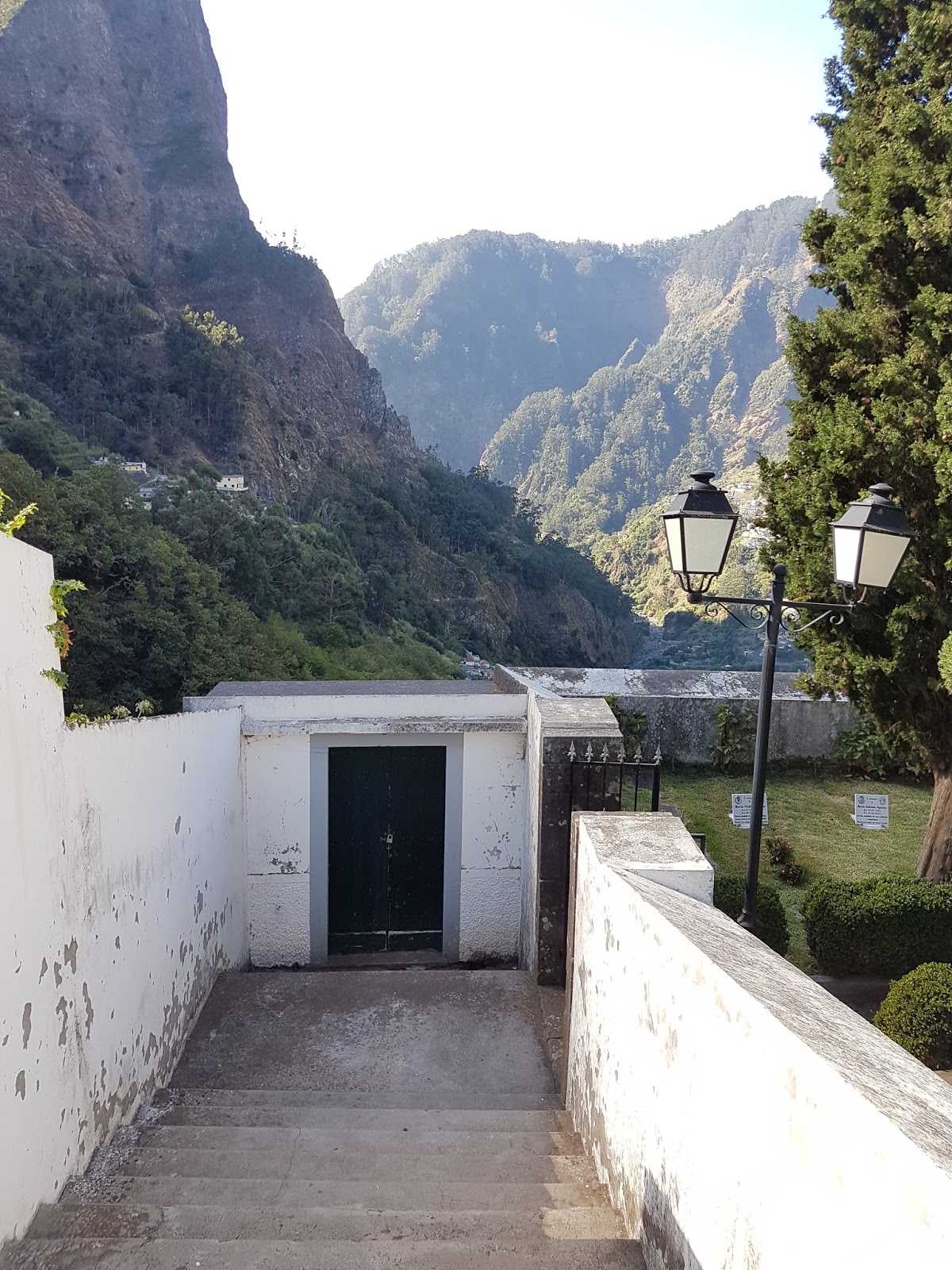
The Fig.6: This small and near cemetery I visited to in the mountainous inland of the island. It is a
part of a monastery of nuns. The monastery had used to be an asylum of the nuns several centuries ago.
I think today the monastery has been a historical and religious memory of the times when the nuns
had lived in the deep valley limited by high mountains without they had to fear of often attacks
 undertaken by pirates on the coastline. Madeira, on October 2016. Taken with my smart phone.
Obr.6: Tento malý a úzký hřbitov jsem navštívil v hornatém vnitrozemí ostrova. Je součástí kláštera
jeptišek. Klášter býval útočištěm jeptišek před několika stoletími. Myslím, že dnes je klášter historickou
a náboženskou vzpomínkou na doby, kdy v tom hlubokém údolí ohraničeném vysokými horami žily
jeptišky, aniž by se musely obávat častých ataků podnikaných piráty na pobřeží. Madeira, říjen, 2016.
Pořízeno mým chytrým mobilem.

Well, I will be a retainer within two years and four months, too. When my time comes I would like coming back to Madeira, to the island where the dying is so sweet.

The Fig.7: Steep lanes of a small mountainous town with a massive rocky shield on the background.
This touristic attraction in the mountainous inland of Madeira has often been visited to by foreign
tourists. The Former monastery of the nuns has been a part of the small town. Madeira, on October,
2016. Taken with my smart phone.
Obr.7: Strmé uličky malého horského města s masivním skalním štítem na pozadí. Tato turistická
atrakce v hornatém vnitrozemí Madeiry je často navštěvována zahraničními turisty. Bývalý klášter
jeptišek je součástí městečka. Madeira, říjen, 2016. Pořízeno mým chytrým mobilem.

This post was done in Madeira already but it has not been published so far. Now, on 11.13. 2016, I am going to publish it at last. I am going to add several more photos only and the post will be ready to start off. The additional photos (from the pic.6 up to the pic.14) come from various places we visited to in the course of our stay at Madeira at the beginning of October 2016.

The Fig.8: I could not help myself but I had to admire this aged madam. Her age category so high 
in the mountainous small town! I had to photograph her incredible vitality. Madeira, on October 2016.
 Taken with my smart phone.
Obr.8: Nemohl jsem si pomoci, ale musel jsem tu letitou dámu obdivovat. Její věková kategorie tak
vysoko v horském městečku. Musel jsem si její neuvěřitelnou vitalitu vyfotografovat. Madeira, říjen
2016. Pořízeno mým chytrým mobilem.


The Czech Version

Sladké umírání na Madeiře

The Fig.9: The church tower and the monastery´s roofs in "the valley of the nuns". Madeira, on
October 2016. Taken with my smart phone.
Obr.9: Kostelní věž a střechy kláštera v "údolí jeptišek". Madeira, říjen 2016. Pořízeno mým
chytrým mobilem. 

Mám rád ostrovy. Mají své zvláštní kouzlo. Madeira je má nejnovější zkušenost. Madeira je ostrovem důchodců. Zdá se, že je jejich oblíbeným místem, kde si mohou užívat poslední zbytky života.

The Fig.10: My shadow above the stairs leading down to the monastery graveyard. Madeira.On
October 2016. Taken with my smart phone.
Obr.10: Můj stín nad schodištěm  vedoucím dolů ke klášternímu hřbitovu. Madeira, říjen 2016.
Pořízeno mým chytrým mobilem.
Můžete si tu zabukovat výlet po moři. To je dnes náš případ. Těším se na to. Hlavní cíl bude pozorování některých kytovců. Rád bych věděl, zda budeme mít kliku některé z těch mořských savců uvidět. Byl bych vděčný aspoň za záblesk ploutve.

The Fig.11: A view of the valley from the monastery. Madeira, on October 2016. Taken with my
smart phone.
Obr.11: Pohled na údolí od kláštera. Madeira, říjen 2016. Pořízeno mým chytrým mobilem.

S důchodci se potkávám po celé Madeiře, jsou všude. Zatím jsem viděl pouze dva menší hřbitovy. Jeden je vedle letiště a druhý jsem viděl v jednom malém přístavu. Druhý byl umístěn pod mostem podél koryta zpola vyschlé řeky.

The Fig.12: The entrance to the graveyard is under the stairs to the right. Madeira, on October 2016.
Taken with my smart phone.
Obr.12: Vchod na hřbitov je pod schody vlevo. Madeira, říjen 2016. Pořízeno mým chytrým
mobilem.
Mám takovou hypotézu. Občas kotví v místním přístavu velká loď. Vidím ji z naší verandy. Představuji si následující obraz: Když se důchodci nalodí, velká loď se vydává na volné širé moře. Důchodci si myslí, že plují k nějaké další ohromující destinaci, ale to je jejich velký omyl. Jakmile jim pobřeží zmizí z dohledu, posádka velkého křižníku je hodí čekajícím žralokům a jiným mořským dravcům. Tímto způsobem je Madeira neustále zbavována rostoucích počtů starších lidí pocházejících z různých částí světa.

The Fig.13: An older tourist was examining the fern at his feet in the Botany Garden when I took
a shot of him. Madeira, Funchal the city, on October 2016. Taken with my smart phone.
Obr.13: Starší turista si prohlížel kapradinu u svých nohou, když jsem si ho vyfotil. Madeira,
Funchal, říjen 2016. Pořízeno mým chytrým mobilem.

Nu, za dva roky a čtyři měsíce budu taky důchodce. Až můj čas nadejde, rád bych se na Madeiru vrátil, na ostrov, kde umírání je tak sladké.

The Fig.14: Do you think we were examining a house for the old people? It is a mistake. We
were passing through the local Botanic Garden in Funchal the city. Madeira, on October 2016.
Taken with my smart phone.
Obr.14: Myslíte, že jsme si prohlíželi nějaký domov pro staré? To je omyl. Procházeli jsme místní
Botanickou zahradou v metropoli Funchal. Madeira, říjen 2016. Pořízeno mým chytrým mobilem.

Tenhle post byl vytvořen už na Madeiře, ale dosud nebyl zveřejněn. Teď, 13.11. 2016, se ho konečně chystám publikovat. Jenom přidám několik dalších fotek a bude nachystán odstartovat. Dodatečné fotografie (od č.6 až po č.14) pocházejí z různých míst, jež jsme navštívili během pobytu na Madeiře počátkem října 2016.