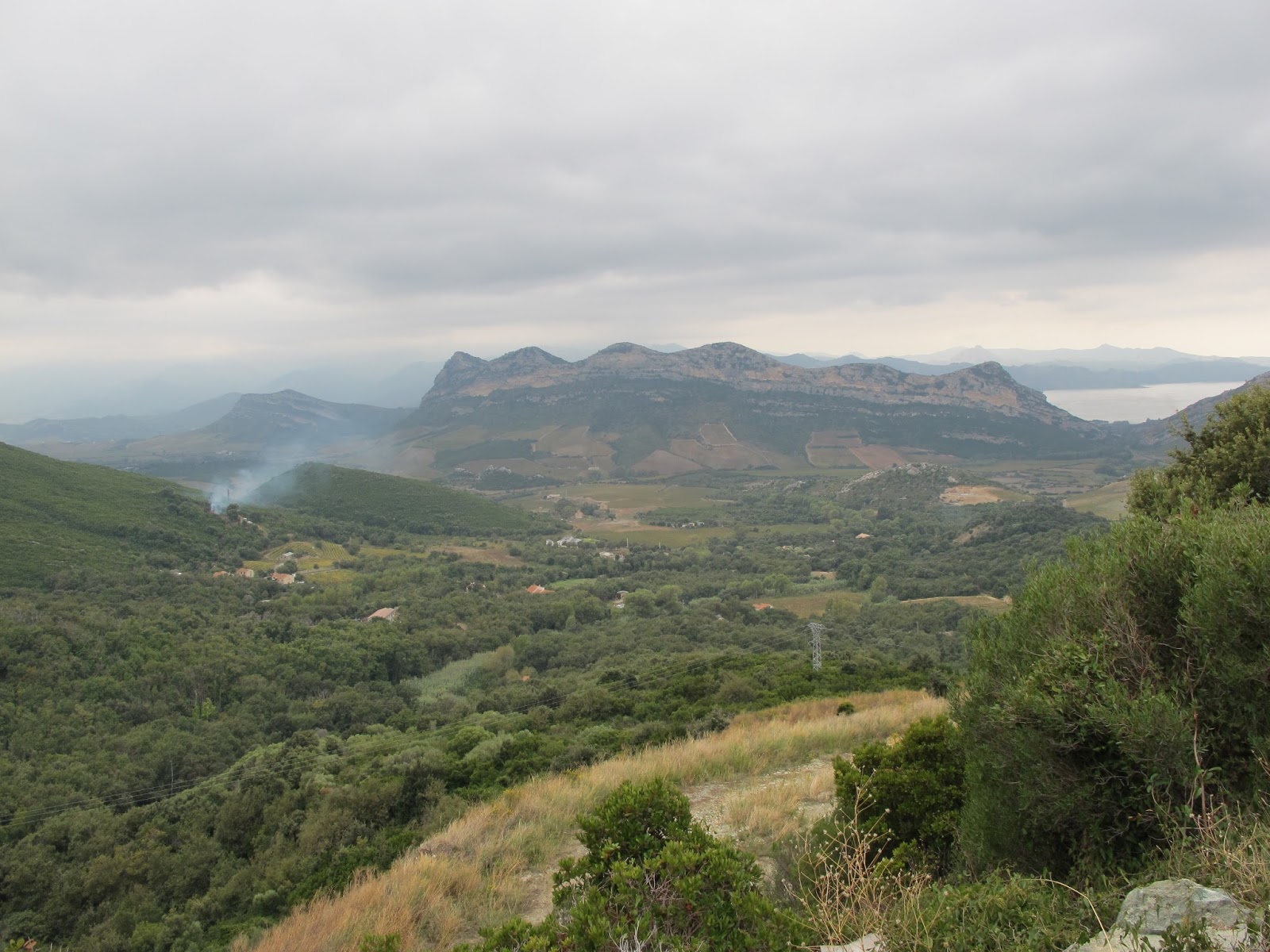
The English Version
Free Memories of Tenerife
(On August, 2016)
 |
The Fig.1: The Tree Dragon (Dracaena draco), this oldest Dragon has still been growing in a small
town called Icod de los Vinos on the north west slanted coast of Tenerife. On August, 2016. Taken
with my smart phone.
Obr.1: Dračinec obrovský (Dracaena draco), tento nejstarší drak pořád roste v městečku Icod de los
Vinos na severozápadním svažitém pobřeží Tenerife. Srpen, 2016. Pořízeno mým chytrým mobilem. |
On The Oldest Dragon in The Island
 |
The Fig.2: Dracaena draco, The Oldest at the closer view. Icod de los Vinos, Tenerife, on August,
2016. Taken with my smart phone.
Obr.2: Dračinec obrovský (D. draco), Nejstarší v bližším pohledu. Icod de los Vinos, srpen, 2016.
Pořízeno mým chytrým mobilem. |
The name of the settlement or the small town where the aged tree has still been standing has not remained in my memory but I could find it with no problem. I am going to do it later. Now I do not want to disturb the flow of my memories of the amazing event.
Just now I can write that the place lays in the North West slopes of the island. Yes, because we went to it by a taxi cab rightly from Los Gigantes, the small port in the south coast, where Robert bought one hour lasting trip on the sea on board of a small motor boat promising our main goal and my long term longing: watching some cetaceans. But this chapter will be a topic of a next post in the future.
 |
The Fig.3: The Oldest Dragon (Dracaena draco), El Drago Milenario in Spanish meaning The
One-Thousand-years-old-Dragon. Its trunk in the more detail. Icod de los Vinos, Tenerife. On August,
2016. Taken with my smart phone.
Obr.3: Nejstarší Drak - dračinec obrovský (D. draco), španělsky El Drago Milenario, což znamená
draka starého jedno tisíciletí. Jeho kmen ve větším detailu. Icod de los Vinos. Tenerife. Srpen, 2016.
Pořízeno mým chytrým mobilem. |
But to be precise I must write that the way from Los Gigantes to the aged Dragon tree was not direct because our first destination between Los Gigantes and the oldest Dragon tree was a small village called Maska. Our taxi cab had to climb a very steep road up to reach it because it sat high above the sea in a mountainous deep and slanted valley locked by huge mountainous walls. Only in this incredible place our taxi driver accepted Robert´s wish to leave for the Dragon tree. Also Maska the village I am going to devote to but in a separate post.
 |
The Fig.4: The underside of the crown of The Oldest (Dracaena draco). Icod de los Vinos,
Tenerife, on August, 2016. Taken with my smart phone.
Obr.4: Spodní strana koruny Nejstaršího (D. draco). Icod de los Vinos. Tenerife, srpen, 2016.
Pořízeno mým chytrým mobilem. |
I saw several cultivated dragon trees in city streets, in squares or they were parts of various city parks and private gardens. From time to time I could glance some individuals of this species growing separately alongside all the roads we could travel by taxi cabs in the whole course of our stay at Tenerife. But I never saw any natural habitat with a natural occurrence of this remarkable and unique botanic curiosity. I never saw any natural Dragon tree wood anywhere throughout Tenerife neither at least a few of the Dragon trees growing together in the wild. And the dragons (let´s call them so in a more familiar way) I saw there were in their youth or in their best years of their lives. Maybe the tallest of them was the one growing in front of a large church in La Laguna the region, the former metropolis of the island and the today´s part of the current metropolis called Santa de la Cruiz where our pension was situated. La Laguna the oldest part of Santa de la Cruiz has stretched out higher in the slopes above the newer part of the whole metropolis. So much for your better orientation.
 |
The Fig.5: Dracaena draco, The Oldest. A detailed shot of its branching and leafy bundles. Tenerife,
on August, 2016. Taken with my smart phone.
Obr.5: Dračinec obrovský (D. draco), Nejstarší. Detailní záběr jeho větvení a listových svazků. Tenerife,
srpen, 2016. Pořízeno mým chytrým mobilem. |
I would say that the cultivation of the Tenerife´s Dragon has been well managed. I am not quite sure of it but it seems to me that in a moment and from a going taxi cab I glanced a shop with plants and flowers for sale where they were offering the Dragon´s seedlings. But we were passing by the shop fast and then hardly my eyes had the chance to read the offer.
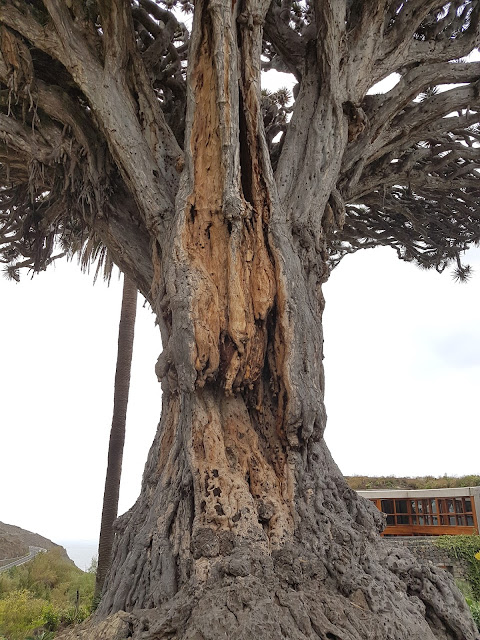 |
The Fig.6: Dracaena draco, The Oldest Dragon. This part of the trunk seems to be damaged. We
can see an uncovered wide vertical wound. Its cause is not known to me. The long vertical open
damage gives us a chance to look into the inner structure of the trunk. Icod de los Vinos, Tenerife,
on August, 2016. Taken with my smart phone.
Obr.6: Dračinec obrovský (D. draco), Nejstarší Drak. Zdá se, že tato část kmene je poškozena. Můžeme
vidět odhalenou širokou kolmou ránu. Její příčinu neznám. Dlouhé svislé kolmé poškození nám dává
možnost nahlédnout do vnitřní struktury kmene. Icod de los Vinos, Tenerife, srpen, 2016. Pořízeno mým
chytrým mobilem. |
Neither of all the dragons was in flower nor in fruit. I could observe only their strange crowns resembling flat heats of some mushrooms. If you stand under a Dragon´s crown (the older tree the better impression) then you can have an impression like you are standing under a strange umbrella or a flat plate. This effect has been especially apparent if you see an older dragon standing somewhere at a distance. The man of the nuclear age might think its silhouette to be a smaller cloud of a smaller atomic explosion though in different hues of dark green, grey and brown.
And if you are standing next to its trunk and if you are taking a look up at the underside of its crown you can examine an astounding system of its branching arranged in a flat circle. Almost you would say that the crown is trimmed by a gardener but it is its natural form.
 |
The Fig.7: My photo with the Oldest Dragon (Dracaena draco). Partly The Oldest is screened by
the house´s corner. The stretch where we saw it at the first time. Icod de los Vinos. Tenerife, on
August, 2016. Taken by my son Robert with my smart phone.
Obr.7: Moje foto s Nejstarším Drakem (Dracaena draco). Částečně je Nejstarší cloněn domovním
nárožím. Úsek, kde jsme ho spatřili poprvé. Icod de los Vinos. Tenerife, srpen, 2016. Pořízeno
synem Robertem mým chytrým mobilem. |
I have already found the name of the place where the Oldest Dragon has still been growing. It is Icod de los Vinos. Our taxi cab stopped in a slanted lane. We got out and while we were going to our goal our cab driver was waiting for us. There was a large park behind the lane. First it spread out in a wide large plateau and then it stepped a long and wide slope up. A part of the plateau under the wide slope was a separate garden. We walked alongside its wall to our right side till we reached its entrance at the opposite direction of our arrival. In fact the garden was screened by a row of houses lining the lane where we left our taxi cab.
 |
The Fig.8: I was very happy. My moment with the Oldest Dragon. Icod de los
Vinos, Tenerife, on August, 2016. Taken by Robert with my smart phone.
Obr.8: Byl jsem velmi šťastný. Má chvilka s Nejstarším Drakem. Icod de los
Vinos, Tenerife, srpen, 2016. Pořízeno Robertem mým chytrým mobilem. |
Next to the entrance was a stand where Robert bought two tickets. The way to the garden and to its most interesting attraction became free to us. But the Oldest Dragon still remained invisible to us. We walked a short sandy path lined with tall vegetation to a wall of a house and turned to the left to continue in our walking a direct section alongside the wall to the right. As soon as we took the left turn we could see it in the opposite end of the stretch. Its high age was obvious at the first glance. In its own way it looked like formidable - a small atomic cloud - standing almost on the corner of the path leading alongside the house´s wall its crown was screened a bit by the house´s corner.
First of all I wanted Robert to take some shots of me and El Drago Milenario as it was named in Spanish meaning The Millennium Dragon. But because we were in a hurry (the waiting taxi cab´s taximeter was running on) and I was under a strong impression of the memorable living being I did not choose the best place for the best photography. Neither Robert found a better place. Simply he took my smart phone and did what I wanted to. He took many versions of me standing in front of the Oldest Dragon. Each of the photos was different because while Robert was taking shots of us I was changing my positions in various ways, mainly I changed positions of my arms and hands. For example I was showing "V" with two my fingers on one shot.
 |
The Fig.9: Dracaena draco, The Oldest Dragon. The structure of its crown at the closer view.
Icod de los Vinos, Tenerife, on August, 2016. Taken with my smart phone.
Obr.9: Dračinec obrovský (D. draco), Nejstarší Drak. Struktura jeho koruny v bližším pohledu.
Icod de los Vinos, Tenerife, srpen, 2016. Pořízeno mým chytrým mobilem. |
Only after this photo-procedure we continued on in our examination of both the Oldest and its close surroundings. With my smart phone in my hands again I was taking my own photos of the Older, of its crown, of its furrowed trunk, of the branching from the crown´s underside, of its leafy bundles, of its whole appearance in the garden and at least but not last also I took a shot of the panels with some information of it. To get the best photos of its whole habitus I made use of the continuing way round the corner. This stretch of the way was direct and it was going in a mild slope up to the back wall of the houses lining the lane with our waiting taxi cab on their opposite side. This place gave me the best view of the Oldest in the garden.
 |
The Fig.10: The information panel explaining why this Dragon Tree has deserved an extraordinary
attention as well as why the Dragon tree has been associated with the dragons. The panel seems
to come from the A.von Humboldt´s times. Compare its text with the text in this post. Icod de los
Vinos, Tenerife, on August, 2016. Taken with my smart phone.
Obr.10: Informační tabule vysvětlující, proč si tento dračinec zasluhuje mimořádnou pozornost a
také, proč je dračinec sdružován s draky. Zdá se, že tabulka pochází z doby A.von Humboldta.
Srovnej její text s textem v tomto postě. Icod de los Vinos, Tenerife, srpen 2016. Pořízeno mým
chytrým mobilem.
The Czech version of the text on the table (Česká verze textu na tabulce):
Dračinec o stáří jednoho tisíce let
Dracanaceae. Dracaena draco
"Makronézský endemit, jediný svého druhu pro své stáří a rozměry (více než 20 metrů vysoký
a o obvodu báze kmene 10 m). Jeho jméno se vztahuje k aspektu draka, jež mění jeho visící
kořeny v hustý plnovous, mízu v rudou krev a propletené větve v množství paží jakési
imaginární bytosti. Existující rozpor s ohledem na jeho stáří odhadované na 1000 - 2000 let a
před dávnou dobou získaný věhlas kvůli dračí krvi (míza, která v kontaktu se vzduchem rudne)
coby léčivém a kosmetickém elixíru (barviva a laky) spojeny s jeho hrozivým aspektem, mění tento
předmět legend a symbolizmů v rostlinu, jež stojí za fascinující a velkolepou návštěvu." |
The Oldest stood nearby the point where the way turned to the right around the corner. It was rising up in a lawn separated from the path by a low barrier. A panel behind the barrier was warning that "to go up to the Oldest Dragon is strictly prohibited".
According to various botanic sources I have learnt that the botanic experts place this strange plant in
Asparagaceae the family (and
Nolinoideae the subfamily). Its botanic name in Latin is
Dracaena draco. Now two subspecies of
Dracaena draco has been recognized by some specialists. The first of Tenerife and Madeira and the second of Morocco. In one source of the Tererife´s flora on the Web I found that
D. draco is endemic to this island but a next source in the Wikipedia presents its endemic occurrence in Madeira, too. But if you consider that the species has grown exclusively in Tenerife only within all the Canary Islands then its endemic occurrence both in Tenerife and Madeira seems to be quite dubious to me. I would judge that its occurrence in Madeira has been secondary rather than primary.
 |
The Fig.11: The base of The Oldest Dragon, Dracaena draco. Icod de los Vinos, Tenerife, on
August, 2016. Taken wit my smart phone.
Obr.11: Báze Nejstaršího draka, dračince obrovského (D. draco). Icod de los Vinos, Tenerife,
srpen, 2016. Pořízeno mým chytrým mobilem. |
Maybe you would like to know an answer to the question: What is the connection between the Dragon Tree (
Dracaena draco) and the dragons? I found two arguments for it. The first is that if a woody part of the Dragon tree is injured then a red brown resin resembling blood is released from the wound. The second sees the connection in the fact that if a branch of the Dragon tree is broken off a new two-forked twig always will sprout out from this point within a time. An analogy with the fairy tales in which a hero cuts a dragon´s head off and next two ones will grow out of its neck in a short time. It is clear that I can´t confirm any of this claims.
The resin called "The Dragon´s blood" has been used in the folk healing but I have not found anything more about it. Also it was added as a dye to the pigment in the production of musical instruments. I learnt that the famous Stradivari fiddle´s pigment has contained an ingredient of the dragon´ s blood, too.
 |
The Fig.12: A part of The Oldest´s trunk full of scars and a part of its branching with the leafy
bundles. The sky was not clear in the time of our visit. Icod de los Vinos, Tenerife, on August,
2016. Taken with my smart phone.
Obr.12: Část kmene Nejstaršího plná šrámů a část jeho větvení s listovými svazky. V době naší
návštěvy obloha jasná nebyla. Icod de los Vinos, Tenerife, srpen 2016. Pořízeno mým chytrým
mobilem. |
The Guanches, the native nation of Tenerife, have been said to worship the Dragon trees. According to one source in the Wikipedia there was found a dragon tree in Tenerife which trunk the natives hollowed in a small sanctuary. But the source tells nothing about if this curious sanctuary has been a part of a museum in Tenerife or not.
As I was standing or wandering in the vicinity of the Oldest I was paying much of my attention to its farrowed trunk. I was wondering at its structure because it did not appear to be one compact trunk but rather it seemed to me to resemble a lot of thin ropes tightly stuck together in one massive bundle. Since the time I could examine the Oldest Dragon personally this mystery had remained to be hidden somewhere at the very edge of my consciousness. I have found the way how the Dragon has been developing its trunk by studying a botanic source in the Wikipedia not too long time before.
The process is possible to divide into four phases.
The Phase one: A young dragon has a single stem for the time of about 15 - 20 years.
The Phase two: The growth of the stem stops and the first spike is developing with white flowers scenting like a lily perfume followed by fruitful coral berries.
The Phase three: Soon after flowering and fruits the terminal buds appear and the plant starts branching.
The Phase four: Each of the branches grows for the time of about 10 - 15 years and then it branches again. This branching process goes on in 10 - 15 years lasting periods till the dragon´s death. And now the best in the end. While the branching occurs the lowest branches of the developing crown are sending air roots down to the soil. They are rooting in it and at the same time they are clinging tightly to the basic trunk thus making it thinner and thinner gradually. The Monocotyledons (
Monocotylodonae) - and the dragon is one of them - can form the wood but they can´t form the right tree rings. This is why the determination of the dragon´s age is not so easy and this is why the dragon´s age has often been overestimated in the past.
For example, the famous German naturalist and explorer A.von Humboldt visited to Tenerife and saw a specimen of the dragon tree to be 21 meters tall and the circumference of its trunk was 15 meters. A. von Humboldt estimated its age to be 6000 years. I would like to know what his concrete reasons were for this estimation.The specimen was destroyed by a storm in 1868. Also the estimations of my Oldest´s age have often been exaggerated considerably in the past. Surely, El Drago Milenario - The One-thousand-years-old Dragon - has been a well meant name to this veteran, it has contributed to its increasing popularity, but it has been far away from the much more sober estimation of its age done by experts in 1975. They has estimated its age to be 250 years with a maximum to 365 years.
 |
The Fig.13: The serpentine structure of The Oldest´s crown (arms or necks) at the closer detail. Icod
de los Vinos, Tenerife, on August 2016. Taken with my smart phone.
Obr.13: Křivolaká struktura koruny (paží či krků) Nejstaršího detailněji. Icod de los Vinos, Tenerife,
srpen 2016. Pořízeno mým chytrým mobilem. |
Well, we spent about 20 or 30 minutes with the Oldest Dragon. Then it was necessary to return to the taxi cab. We passed through an open atrium next to the garden. There were some restaurants and fast food stands in a passage behind the atrium. Passing through the atrium I noticed a parrot in a cage. I was trying to photograph it through bars of the cage but my efforts were not much successful. Then we left the passage behind us and we were in the slanted lane again. Our taxi cab was parking obediently a couple of meters above us. A moment later we got in and the taxi cab started up going to its last goal, to our temporary home in Santa de la Cruiz. The day was very fruitful!
The Czech Version
Volné vzpomínky na Tenerife
(Srpen, 2016)
 |
The Fig.14: A multitude of The Oldest´s arms on the background of the grey sky. Icod de los Vinos,
Tenerife, on August 2016. Taken with my smart phone.
Obr.14: Množství paží Nejstaršího na pozadí šedé oblohy. Icod de los Vinos, Tenerife, srpen, 2016.
Pořízeno mým chytrým mobilem. |
O Nejstarším Drakovi na ostrově
 |
The Fig.15: A Warning panel prohibiting tight contacts with The Oldest Dragon. As you can see
the white ropes are more or lesser a symbolical barrier separating visitors from it. Icod de los Vinos,
Tenerife, on August 2016. Taken with my smart phone.
Obr.15: Varovná tabulka zakazující těsné kontakty s Nejstarším drakem. Jak můžete vidět, bílé provazy
jsou více méně symbolickou zábranou, která od něj návštěvníky odděluje. Icod de los Vinos, Tenerife,
srpen 2016. Pořízeno mým chytrým mobilem. |
Jméno osady či městečka, kde ten letitý strom pořád stojí mi v paměti nezůstalo, ale bez problému bych ho mohl vyhledat. Hodlám to udělat později. Teď nechci narušovat tok svých vzpomínek na tu úžasnou událost.
Právě v tuto chvíli mohu napsat, že to místo leží na severo západních svazích ostrova. Ano, protože jsme do něj jeli taxíkem rovnou z Los Gigantes, malého přístavu na jižním pobřeží, kde Robert zakoupil hodinový výlet na moři, na palubě malého motorového člunu, slibující náš hlavní cíl a mou dlouhodobou touhu: pozorování kytovců. Ale tahle kapitola bude tématem nějakého dalšího postu v budoucnosti.
Avšak, abych byl přesný, musím napsat, že cesta z Los Gigantes k letitému dračinci nebyla přímá, protože naší první destinací mezi Los Gigantes a nejstarším dračincem byla malá víska zvaná Maska. Aby jí dosáhl, musel náš taxík vyšplhat velmi strmou silnicí, protože sedí vysoko nad mořem v horském hlubokém a svažitém údolí sevřeném obrovskými horskými stěnami. Teprve na tomto místě přijal náš taxíkář Robertovo přání odjet za dračincem. Rovněž vísce Maska se hodlám věnovat, ale v samostatném postě.
 |
The Fig.16: A view of Icod de los Vinos from a place above the garden with The Oldest. You
can see a typical silhouette of its younger counterpart. Tenerife, on August 2016. Taken with
my smart phone.
Obr.16: Pohled na Icod de los Vinos z místa nad zahradou s Nejstarším. Můžete vidět typickou
siluetu jeho mladšího protějšku. Tenerife, srpen 2016. Pořízeno mým chytrým mobilem. |
Viděl jsem několik pěstovaných dračinců v městských ulicích, na náměstích, anebo byly součástí různých městských parků a soukromých zahrad. Občas jsem mohl letmo zahlédnout některé jedince tohoto druhu, rostoucí podél všech těch silnic, po nichž jsme taxíky cestovali během celého pobytu na Tenerife. Avšak nikdy jsem neviděl žádnou přirozenou lokalitu s přirozeným výskytem téhle pozoruhodné a jedinečné botanické zvláštnosti. Nikdy jsem nikde po celém Tenerife nespatřil žádný přirozený dračincový háj, ani alespoň pár dračinců rostoucích pohromadě ve volné přírodě. A draci (říkejme jim tak důvěrněji), jež jsem viděl, byli mladí či v nejlepších letech života. Snad nejvyšší z nich rostl před jedním velkým kostelem v oblasti La Laguna, bývalé metropoli ostrova a dnešní součásti současné metropole zvané Santa de la Cruiz, kde byl situován náš penzion. La Laguna, nejstarší součást Santa de la Cruiz se prostírá výše ve svazích nad novější částí hlavního města. Tolik pro vaši lepší orientaci.
Řekl bych, že kultivace tenerifského draka je dobře zvládnutá. Nejsem si tím zcela jistý, ale zdá se mi, že v jednom momentě a z jedoucího taxíku jsem letmo zahlédl krámek s rostlinami a květinami na prodej, kde nabízeli drakovy semenáčky. Avšak projížděli jsme kol krámku rychle, a tudíž můj zrak měl sotva šanci tu nabídku přečíst.
 |
The Fig.17: The same view as on the previous picture in the more detail. Icod de los Vinos,
Tenerife, on August 2016. Taken with my smart phone.
Obr.17: Tentýž pohled jako na předešlém obrázku detailněji. Icod de los Vinos, Tenerife, srpen
2016. Pořízeno mým chytrým mobilem. |
Žádný ze všech těch draků nebyl v květu nebo v plodu. Mohl jsem pozorovat pouze jejich zvláštní koruny, které se podobají plochým kloboukům některých hub. Stojíte-li pod dračí korunou (čím starší strom, tím lepší dojem), pak můžete mít dojem, že stojíte pod podivným parapletem nebo plochým talířem. Tento efekt je zvlášť zjevný, díváte-li se na staršího draka, který stojí někde v dálce. Člověk jaderného věku by snad mohl jeho siluetu považovat za obláček menšího atomového výbuchu, třebaže v odlišných odstínech tmavě zelené, šedé a hnědé.
A stojíte-li vedle jeho kmene a vzhlédnete-li ke spodině koruny, můžete si prohlížet jeho úžasnou soustavu větvení uspořádanou v plochém kruhu. Skoro byste řekli, že korunu zastřihuje zahradník, ale je to její přirozený tvar.
Už jsem našel jméno toho místa, kde Nejstarší Drak stále roste. Je to Icod de los Vinos. Taxík zastavil v šikmé uličce. Vystoupili jsme a zatímco jsme šli ke svému cíli, taxíkář na nás čekal. Za uličkou byl rozlehlý park. Zprvu se rozprostíral v širokou rozlehlou plošinu a poté vystupoval širokým táhlým svahem vzhůru. Součástí plošiny pod širokým svahem byla oddělená zahrada. Kráčeli jsme podél její zdi po pravé straně, dokud jsme nedospěli ke vstupu v opačném směru našeho příchodu. Zahrada byla vlastně cloněna řadou domů lemujících uličku, kde jsme opustili taxík.
 |
The Fig.18: One of my first photos of The Oldest. This one is with my son Robert studying
something at his feet. Icod de los Vinos, Tenerife, on August 2016. Taken with my smart phone.
Obr.18: Jedna z mých prvních fotek Nejstaršího. Tahle je se synem Robertem studujícím cosi
u svých nohou. Icod de los Vinos, Tenerife, srpen 2016. Pořízeno mým chytrým mobilem. |
Vedle vstupu byl stánek, kde Robert zakoupil dva lístky. Cesta do zahrady a k její nejzajímavější atrakci se nám uvolnila. Ale Nejstarší Drak pro nás stále zůstával neviditelný. Došli jsme krátkou písčitou pěšinou lemovanou vysokou vegetací ke zdi domu a odbočili doleva, abychom v chůzi pokračovali přímým úsekem podél zdi vpravo. Jakmile jsme zabočili vlevo, mohli jsme ho vidět na opačném konci úseku. Jeho vysoký věk byl zřejmý na první pohled. Svým vlastním způsobem vyhlížel podivínsky - malý atomový mrak - stojící téměř za rohem cesty, která vedla podél domovní zdi a jeho koruna byla trochu cloněna domovním nárožím.
Nejdřív ze všeho jsem chtěl, aby Robert vyfotil mě s El Drago Milenario, jak je nazýván španělsky, což značí Tisíciletý Drak. Ale protože jsme spěchali (taxametr čekající drožky pořád běžel) a já byl pod silným dojmem té památné živé bytosti, nezvolil jsem nejlepší místo pro nejlepší fotku. Ani Robert lepší místo nehledal. Prostě si vzal můj chytrý mobil a dělal, co jsem chtěl. Pořídil mnoho verzí toho, jak stojím před Nejstarším Drakem. Každá z těch fotek je jiná, protože, zatímco nás Robert fotil, měnil jsem různě pozice, hlavně jsem měnil pozice paží a rukou. Například na jedné fotce jsem dvěma prsty ukazoval "V".
 |
The Fig.19: A view of an eroding left side of The Oldest Dragon. Icod de los Vinos,
Tenerife, on August 2016. Taken with my smart phone.
Obr.19: Pohled na erodující levý bok Nejstaršího Draka. Icod de los Vinos, Tenerife,
srpen 2016. Pořízeno mým chytrým mobilem. |
Teprve po téhle foto-procedúře jsme pokračovali v prohlídce Nejstaršího i jeho blízkého okolí. S chytrým mobilem opět v rukách jsem si pořizoval vlastní fota Nejstaršího, jeho koruny, jeho vrásčitého kmene, větvení spodní strany koruny, listových svazků, jeho celkového vzhledu v zahradě a v neposlední řadě jsem také vyfotografoval tabulky s nějakými informacemi o něm. Abych získal nejlepší fotografie jeho celkového vzezření, využil jsem pokračující cesty za rohem. Tento úsek cesty byl přímý a v mírném svahu stoupal k zadní hradbě domů lemujících uličku s naším čekajícím taxíkem na její opačné straně. Toto místo poskytlo na Nejstaršího v zahradě nejlepší pohled.
Nejstarší stál poblíž bodu, kde cesta kolem rohu zahýbala doprava. Tyčil se na trávníku odděleném od cesty nízkou zábranou. Cedulka za zábranou upozorňovala, že "chodit až k Nejstaršímu Drakovi se přísně zakazuje".
Podle různých botanických zdrojů se dozvídám, že botaničtí odborníci řadí tuto zvláštní rostlinu do čeledi chřestovitých (
Asparagaceae). Její latinský botanický název je
Dracaena draco (dračinec obrovský). Někteří specialisté dnes rozpoznávají dva poddruhy dračince obecného (
D. draco). První z Tenerife a Madeiry a druhý z Maroka. V jednom zdroji o flóře Tenerife ve Wikipedii jsem našel, že dračinec obrovský (
D. draco) je pro tento ostrov endemický, avšak další zdroj ve Wikipedii uvádí jeho endemický výskyt také na Madeiře. Jestliže ale uvážíte, že tento druh roste výhradně na Tenerife v rozsahu celého Kanárského souostroví, pak se mi jeho endemický výskyt na Tenerife i na Madeiře zdá dost pochybný. Soudil bych, že jeho výskyt na Madeiře je spíše sekundární než primární.
 |
The Fig.20: The symbol of my fingers expressing my great joy of the Oldest Dragon. Icod de los
Vinos, Tenerife, on August 2016. Taken by Robert with my smart phone.
Obr.20: Symbol mých prstů vyjadřující velkou radost z Nejstaršího Draka. Icod de los Vinos,
Tenerife, srpen 2016. Pořízeno Robertem mým chytrým mobilem. |
Možná byste rádi znali odpověď na otázku: Jaká je spojitost mezi dračincem a draky? Našel jsem pro to dva argumenty. První spočívá v tom, že poraní-li se nějaká dřevnatá část dračince, pak se z rány uvolňuje červenohnědá pryskyřice připomínající krev. Druhý vidí spojitost ve faktu, že je-li z dračince odlomena větev, za čas v tom bodě vyraší nová větévka vždy o dvou vidlicích. Obdoba s pohádkovou situací, v níž hrdina utíná drakovi hlavu a v krátké době mu z krku vyrostou další dvě hlavy. Je jasné, že ani jedno z těch tvrzení potvrdit nemohu.
Pryskyřice zvaná "dračí krev" se používala v lidovém léčitelství, ale nic víc jsem o tom nenašel. Také se přidávala jako barvivo do laku při výrobě hudebních nástrojů. Dozvěděl jsem se, že lak slavných houslí Stradivari obsahuje také přísadu dračí krve.
Guančové, původní národ Tenerife, prý dračince uctívali. Podle jednoho zdroje na Wikipedii byl na Tenerife nalezen kmen dračince, v němž si domorodci vydlabali malou svatyni. Zdroj však neříká nic o tom, zda tahle kuriózní svatyně je či není součástí některého tenerifského muzea.
 |
The Fig.21: On our back way to the taxi cab I took this quick shot of a parrot in a cage in the
atrium behind The Oldest´s garden. Icod de los Vinos, Tenerife, on August 2016. Taken with
my smart phone.
Obr.21: Na zpáteční cestě k taxíku jsem udělal tento rychlý obrázek papouška v kleci v atriu za
zahradou Nejstaršího. Icod de los Vinos, Tenerife, srpen 2016. Pořízeno mým chytrým mobilem. |
Jak jsem postával nebo bloumal v blízkosti Nejstaršího, hodně pozornosti jsem věnoval tomu vrásčitém kmeni. Žasnul jsem nad jeho strukturou, protože se nezdál být jedním kompaktním kmenem, ale spíš mi připadalo, že připomíná silná lana slepená těsně dohromady v jeden masivní svazek. Od té doby, co jsem si Nejstaršího Draka mohl prohlížet osobně, zůstávala tahle záhada skrytá kdesi na samé hraně mého vědomí. Způsob, jak Drak vyvíjí svůj kmen, jsem našel při studiu jednoho botanického zdroje na Wikipedii před nepříliš dlouhou dobou. Ten proces je možné rozdělit na čtyři fáze.
Fáze první: Mladý drak má jeden kmen po dobu asi 15 - 20 let.
Fáze druhá: Růst kmene se zastavuje a vyvíjí se první květenství s bílými květy, jež voní jako liliový parfém, a poté plodné korálkové bobule.
Fáze třetí: Brzy po kvetení a plodech se objevují terminální pupeny a rostlina se začíná větvit.
Fáze čtvrtá: Každá z větví roste po dobu asi 10 - 15 let a pak se znovu větví. Tento proces větvení pokračuje v deseti až patnáctiletých periodách až do Drakovy smrti. A teď to nejlepší na konec. Zatímco probíhá větvení, nejspodnější větve rozvíjející se koruny sesílají do půdy vzdušné kořeny. Zakořeňují v ní a současně těsně lnou k základnímu kmeni, čímž způsobují, že postupně tloustne a tloustne. Jednoděložné (
Monocotyledonae) - a Drak je jedním z nich - umí tvořit dřevo, ale neumí vytvářet pravé letokruhy. Proto určení dračího věku není tak snadné, a proto byl jeho věk v minulosti často odhadován přehnaně.
Například slavný německý přírodovědec A. von Humoldt navštívil Tenerife a viděl exemplář dračince o výšce 21 m a obvodu kmene 15 m. A. von Humboldt odhadl jeho stáří na 6000 let. Rád bych věděl, jaké byly jeho konkrétní důvody k tomuto odhadu. Tento exemplář zničila v roce 1868 bouře. Také odhady věku mého Nejstaršího se v minulosti často značně přeháněly. Jistě, El Drago Milenario - Tisíc let starý drak - je dobře míněné jméno pro tohoto veterána, přispívá k jeho roustoucí popularitě, avšak je daleko vzdáleno od mnohem střízivějšího odhadu provedeného odborníky v r. 1975. Ti jeho stáří odhadli na 250 let s maximem do 365 let.
 |
The Fig.22: A finger-post pointing at the direction of The Oldest´s garden in a street of Icod de
los Vinos. Tenerife, on August 2016. Taken with my smart phone.
Obr.22: Směrovník ukazující ve směru zahrady Nejstaršího v jedné ulici Icod de los Vinos.
Tenerife, srpen 2016. Pořízeno mým chytrým mobilem. |
S Nejstarším Drakem jsme strávili asi 20 či 30 minut. Pak bylo nezbytné vrátit se k taxíku. Prošli jsme jakýmsi otevřeným atriem vedle zahrady. V průchodu za atriem byly restaurace a stánky s rychlým občerstvením. Při průchodu atriem jsem si všiml papouška v kleci. Snažil jsem se ho vyfotit přes mříže klece, ale má snaha nebyla moc úspěšná. Pak jsme pasáž nechali za sebou a opět jsme byli ve svažité uličce. Naše taxi poslušně parkovalo pár metrů nad námi. O chvíli později jsme nastoupili a taxík se rozjel ke svému poslednímu cíli, k našemu přechodnému domovu v Santa de la Cruiz. Byl to velmi plodný den!
 |
The Fig.23: We are approaching to our waiting taxi cab. Icod de los Vinos, Tenerife, on August
2016. Taken with my smart phone.
Obr.23: Blížíme se k našemu čekajícímu taxíku. Icod de los Vinos, Tenerife, srpen 2016.
Pořízeno mým chytrým mobilem. |